
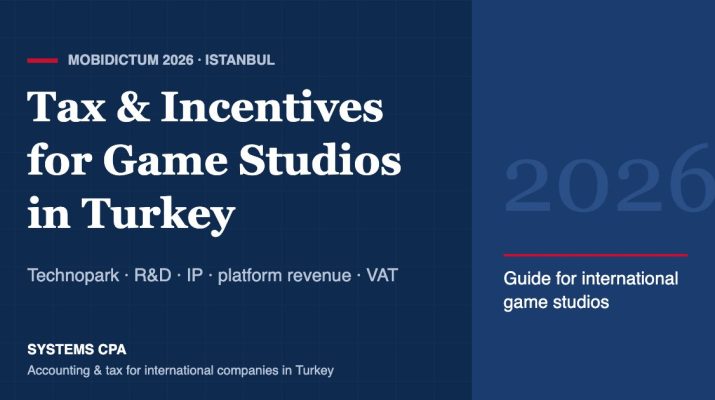
Mobidictum 2026: A Tax and Incentives Guide for International Game Studios in Türkiye
For international game studios arriving in Istanbul for Mobidictum 2026, Türkiye offers more than access to a growing gaming ecosystem. The right operating structure may also provide access to R&D, technology, employment and export-related incentives — but the structure should be designed before incorporation, not after it.
Mobidictum Conference 2026 brings founders, publishers, investors, developers and technology companies from across the global games industry to Istanbul on 7–8 October 2026. For overseas studios looking beyond the conference itself, the more strategic question is whether Türkiye could serve as a development centre, regional operating company, publishing platform or technology hub.
That decision should not begin with a standard company incorporation package. For a gaming business, the tax consequences can vary materially depending on where the intellectual property is owned, how developers are employed, how platform income is characterised and which entity contracts with publishers, platforms and end customers.
Why international game studios are looking at Türkiye
Türkiye has developed a substantial technology and gaming talent pool, particularly in Istanbul and Ankara. International founders evaluating Türkiye commonly consider the country for one or more of four functions:
Game Development
Building a Turkish development team covering software engineering, game design, data, art and product functions.
Regional Operations
Using Türkiye as an operating base for Europe, MENA, Central Asia and surrounding markets.
R&D and Technology
Assessing whether qualifying development activities may fall within Türkiye’s technology and R&D incentive frameworks.
International Revenue
Structuring income received from publishers, app stores, gaming platforms and overseas group companies.
1. Do you need a Turkish company?
Foreign investors can generally establish and own Turkish companies. The two principal corporate forms used by international investors are the limited liability company and the joint stock company.
For many early-stage and privately held gaming businesses, a Turkish limited liability company may provide a sufficiently straightforward operating vehicle. A joint stock company may be considered where the investment structure, share transfers, governance model, future financing or exit strategy requires a more corporate framework.
The more important question, however, is not simply which legal form to choose. It is what the Turkish company will actually do.
- Will it own or develop intellectual property?
- Will it invoice the foreign parent company?
- Will it contract directly with Steam, Apple, Google, Roblox or another platform?
- Will it employ developers?
- Will it receive royalties?
- Will it provide development services to another group entity?
- Will it become the principal entrepreneurial entity of the group?
These are tax-structuring questions rather than incorporation formalities.
For a broader overview of ownership, capital, incorporation and ongoing compliance, see our guide to setting up a company in Turkey as a foreign investor.
2. Technology and R&D incentives
Türkiye operates several incentive regimes relevant to technology businesses. Depending on the activity, location, personnel profile and operating model, a gaming company may need to review frameworks such as Technology Development Zones and the R&D legislation.
Game development should not automatically be assumed to qualify simply because the company operates in the technology sector. Eligibility must be assessed by reference to the actual project, functions performed, personnel involved, location of the activities and the applicable incentive legislation.
3. Technopark or ordinary Turkish company?
International founders often hear about Turkish Technology Development Zones — commonly referred to as Technoparks — before establishing their company.
A Technopark structure can be highly relevant for qualifying software and technology activities, but it should not be treated as a generic low-tax incorporation solution.
The analysis should consider:
- whether the project itself qualifies;
- which revenues are connected with qualifying activities;
- which employees perform qualifying functions;
- where the relevant work is physically carried out;
- how non-qualifying commercial activities will be separated; and
- how the structure interacts with IP ownership and international group arrangements.
For some studios, an ordinary Turkish company using a different R&D framework may be more appropriate. For others, a Technology Development Zone may be central to the operating model.
The answer should follow the business model rather than the other way around.
4. Platform revenue: not all gaming income is the same
One of the most important tax questions for gaming companies is the legal and economic character of their revenue.
A payment received from an overseas platform is not automatically “service income” merely because it originates outside Türkiye. Equally, every payment connected with intellectual property should not automatically be treated as royalty income.
The underlying contract matters.
| Revenue Model | Questions to Review |
|---|---|
| App Store / Google Play | Who sells to the user, who owns the game, how platform fees are structured and what contractual rights are granted? |
| Steam | What rights are granted to Valve, how are distributions characterised and who remains the owner of the underlying IP? |
| Roblox | Are payments connected with development services, creator activity, licensing or use of IP and digital assets? |
| Publisher Agreement | Is the publisher purchasing services, licensing IP, receiving distribution rights or funding development? |
| Intercompany Development | Is the Turkish company a routine service provider or does it economically create and control valuable IP? |
These distinctions may affect corporate taxation, withholding tax, VAT analysis, transfer pricing, export incentives and the application of international tax treaties. Studios distributing through a cross-border platform should also note the separate regulatory and local-presence rules that now apply to foreign game platforms in Turkey.
5. Service export incentives require closer analysis
Türkiye provides significant tax support for certain qualifying services supplied to overseas customers. Following the recent expansion of the relevant service-export regime, international technology businesses are understandably examining whether development activities performed from Türkiye may benefit.
Gaming companies should be careful, however, not to assume that every foreign-currency payment received from abroad represents qualifying exported services.
A proper analysis should generally establish:
- the identity and residence of the customer;
- the contractual nature of the service;
- where the service is performed;
- where and by whom the service is utilised;
- whether the payment is genuinely consideration for a service;
- whether IP or licensing rights are embedded in the arrangement; and
- whether the statutory conditions for the relevant deduction are satisfied.
This distinction can be particularly important where a studio has completed development of a game or digital asset and subsequently derives income from licensing, exploitation or distribution of that IP.
6. Where should the game IP be owned?
For international gaming groups, the location of intellectual property ownership can become more important than the place of incorporation.
A common model is to maintain IP ownership in an overseas parent company while the Turkish subsidiary provides development services. Another possibility is for the Turkish entity itself to develop and own all or part of the relevant IP.
Neither structure is inherently correct.
The appropriate model depends on where the key development functions, decision-making, financing, risk control and exploitation of the IP actually take place.
If a Turkish development team creates substantial value while another group company legally owns the IP, transfer pricing becomes especially important. The remuneration of the Turkish entity should reflect its real functions, assets and risks.
7. Hiring developers in Türkiye
Establishing a Turkish development team introduces payroll, social security and employment compliance requirements in addition to corporate tax considerations.
Depending on the applicable incentive regime, qualifying R&D or technology personnel may also be relevant to payroll-related incentives. The company should therefore determine from the beginning which employees belong to qualifying development projects and maintain the necessary supporting records.
International groups should also review arrangements involving:
- foreign employees working in Türkiye;
- work permits and immigration status;
- remote employees;
- founders acting as managers;
- employee stock options and equity incentives; and
- intercompany secondments.
8. VAT and cross-border transactions
Cross-border gaming transactions can create complex VAT questions. Whether a supply is treated as a service, licensing transaction, electronically supplied service or another category should be analysed based on the underlying contractual relationship.
Where the Turkish company supplies services to an overseas entity, eligibility for Turkish VAT export treatment should also be reviewed separately from corporate income tax incentives.
Larger international platforms should also separately consider whether Turkey’s Digital Services Tax rules may apply to their business model.
9. Four structures we commonly analyse
For an international gaming group entering Türkiye, the first-stage structuring exercise often involves comparing several possible models.
1
Turkish development subsidiary
The overseas parent owns the IP and the Turkish company provides
development services under an intercompany agreement.
2
Turkish IP and operating company
The Turkish entity develops, owns and commercialises the game or related
technology.
3
Technology Development Zone structure
Qualifying development activities are operated within an approved
technology-zone framework while other commercial activities are
separately managed.
4
Regional operating hub
Türkiye is used for development and selected regional commercial
functions, potentially including local employment, regional management
and support activities.
Each model produces different outcomes in relation to taxation, transfer pricing, IP, VAT, employment and incentives.
10. What should be reviewed before incorporation?
For founders visiting Istanbul during Mobidictum week, an effective preliminary review does not require a lengthy feasibility exercise. However, several questions should ideally be answered before a Turkish company starts trading.
| Area | Pre-entry Question |
|---|---|
| Corporate Structure | What should the Turkish entity actually do? |
| IP | Which entity will legally and economically own the game? |
| Revenue | Are receipts service fees, platform revenues, royalties or another form of income? |
| Incentives | Which development activities and personnel may qualify? |
| Transfer Pricing | How should the Turkish company be remunerated within the group? |
| Employment | Who will work in Türkiye and under which employment structure? |
| VAT | How should domestic and cross-border supplies be treated? |
| Compliance | What accounting, tax, payroll and reporting infrastructure is required? |
International groups considering a Turkish subsidiary may also find our 10 Questions Foreign Companies Ask Before Setting Up in Turkey useful for ownership, capital, tax and compliance fundamentals.
Mobidictum 2026: use the week to test the structure, not just the market
Mobidictum creates an opportunity for international studios to meet publishers, investors, platforms and other participants in Türkiye’s gaming ecosystem.
For companies considering a more permanent presence, the same visit can also be used to determine whether a Turkish development or operating structure is commercially and fiscally viable.
The optimal answer may be a Turkish subsidiary, a Technology Development Zone structure, a cross-border development arrangement or no Turkish company at all.
What matters is establishing that answer before contracts, employees and intellectual property are placed into a structure that later becomes difficult to change.
In Istanbul for Mobidictum 2026?
SystemsCPA advises international gaming and technology companies on Turkish market entry, company formation, tax structuring, R&D and technology incentives, transfer pricing, payroll and the tax treatment of cross-border platform and IP revenues.
If you are evaluating Türkiye as a development centre or regional operating base, we can provide an initial structuring review covering the proposed operating model, available incentives and the principal Turkish tax and compliance considerations.
Discuss Your Turkey StructureTurn Turkey compliance into certainty
SYSTEMS CPA supports foreign-owned companies with company formation, accounting, tax compliance and payroll in Turkey — one accountable local partner. Reviewed by Evren Özmen, SMMM (Certified Public Accountant), TÜRMOB Reg. No. 35675.
