Accounting services in Turkey · for foreign-owned companies, subsidiaries and branches
Peace of mind, not a pile of technical tasks. SYSTEMS CPA runs the accounting function of your Turkish company: statutory accounts kept to Turkish standard, tax and payroll filings coordinated on one calendar, a disciplined monthly close, and an English reporting pack your head office can rely on.
Short answer. Accounting services in Turkey for a foreign-owned company cover four connected layers: statutory accounting under the Tax Procedure Law and the Uniform Chart of Accounts, the monthly tax and payroll filings that are generated from those books, a reconciled month-end close, and reporting to head office. A licensed Turkish CPA must keep the statutory books; the parent company decides how much of the wider finance function it keeps in-house.
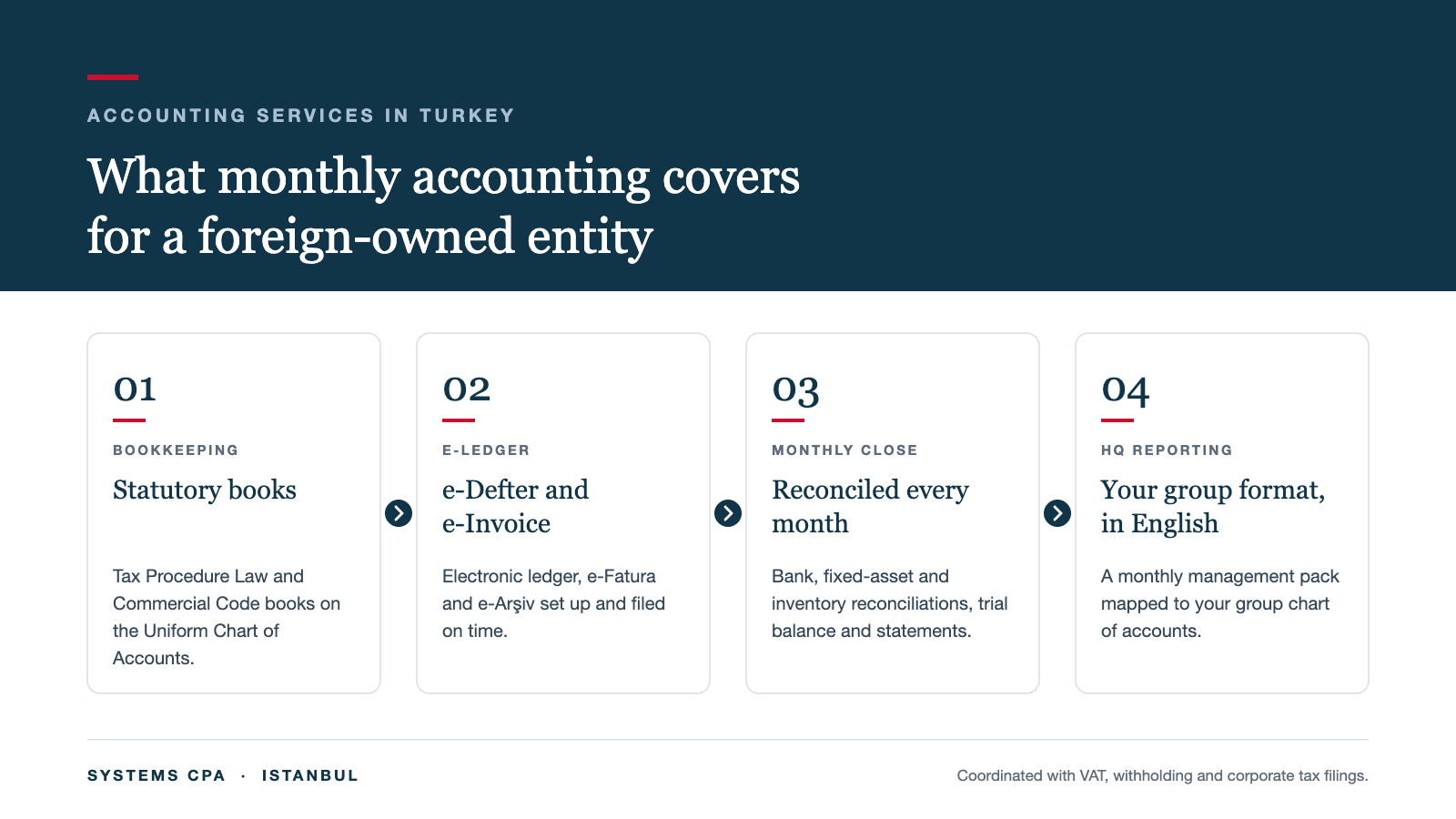
Accounting services in Turkey at a glance
| Who it is for | Foreign-owned companies, subsidiaries and branches operating in Turkey |
| What is included | Statutory accounting, bookkeeping and e-Ledger, VAT, withholding and corporate-tax filings, payroll accounting, monthly close and reporting |
| Service models | Full outsourcing, co-sourced statutory layer, or statutory and tax review |
| Standards | Turkish Tax Procedure Law No. 213, Commercial Code No. 6102 and the Uniform Chart of Accounts |
| Reporting | Monthly management pack in your group format and in English |
| Language | English and Turkish — one point of contact for your HQ |
| Handled by | Certified Public Accountant, TÜRMOB Reg. No. 35675, Istanbul |
Who does accounting for foreign companies in Turkey?
In Turkey, keeping a company’s statutory books for it is a licensed profession: under Law No. 3568 it is reserved to Certified Public Accountants and Sworn-in CPAs registered with TÜRMOB. Foreign-owned companies therefore appoint a licensed local firm such as SYSTEMS CPA to keep the electronic ledger, prepare the tax filings, run payroll and report monthly. The parent company keeps oversight; the licensed local accountant carries the professional responsibility for the books.
Can a foreign company use a remote accountant or CPA in Turkey?
Yes. The Turkish entity’s statutory books, e-Ledger, VAT and tax filings and payroll are handled in Turkey by a CPA licensed under Law No. 3568, while the parent company works with us remotely in English: documents are shared digitally and a monthly management pack goes to head office. Office visits are optional.
What do accounting services in Turkey include?
For an operating company, accounting in Turkey is not simply data entry. A foreign-owned Turkish company needs a finance process that records and controls its transactions, produces the tax and payroll filings that are built from those records, and gives management numbers it can act on. The scope depends on activity, transaction volume, headcount, ERP environment, cross-border payments and group reporting requirements.
| Accounting area | Typical scope | What head office should receive |
|---|---|---|
| Bookkeeping | Sales, purchases, expenses, banks, fixed assets and general-ledger entries — see bookkeeping services in Turkey | A complete, reconciled trial balance |
| Tax compliance | VAT, withholding, provisional and annual corporate tax, stamp tax — see tax compliance in Turkey | Filed positions, payment schedule and explanations of material tax items |
| Payroll accounting | Payroll entries, employee liabilities and SGK balances — see payroll services in Turkey | Payroll register, employer cost and reconciled payroll balances |
| Electronic compliance | e-Invoice, e-Archive and e-Ledger processes | Evidence that electronic outputs agree with the books |
| Month-end close | Reconciliations, accruals, cut-off, intercompany alignment and account review | Reliable monthly financial information |
| Group reporting | Mapping of Turkish accounts to the group chart of accounts | An English pack aligned with the parent’s close timetable |
Comparing accounting providers? Review our three scope-based accounting and finance service packages, from statutory compliance to CFO reporting. To see what headquarters could receive, open the illustrative monthly reporting pack.
Three accounting models for foreign companies in Turkey
The right model depends on who will record the day-to-day transactions. A new or small subsidiary usually outsources almost everything. A group running SAP, Oracle, NetSuite or Dynamics through a shared service centre often keeps transaction processing and buys only the Turkish statutory and tax layer. A larger Turkish operation with its own accounting team may need an external CPA mainly for review, filings and technical questions.
| Model | Who records transactions | What SYSTEMS CPA does | Usually suits |
|---|---|---|---|
| Full outsourcing | SYSTEMS CPA | Bookkeeping, statutory accounting, tax and payroll filings, close and reporting | New subsidiaries and entities without a local finance team |
| Co-sourced statutory layer | Your finance team or shared service centre, in the group ERP | Turkish statutory review, tax adjustments, VAT, withholding and corporate-tax compliance, e-Ledger coordination and the filing calendar | Multinationals with a global ERP and a fixed group close |
| Statutory and tax review | An in-house Turkish accounting department | Review of positions, filing support, technical tax analysis and audit support | Larger Turkish operations with an established local team |
Who owns what in a co-sourced model?
Co-sourcing only works when ownership is written down. At onboarding we agree a responsibility matrix: your team owns transaction processing, the general ledger, intercompany entries and the group package; SYSTEMS CPA owns the Turkish tax computations, local filings, statutory adjustments and the local compliance calendar; information requests from auditors or the tax office are handled jointly, with your team supplying group data and us coordinating locally. The question is not who enters the invoice — it is who reviews the Turkish statutory position, who turns accounting data into tax filings, and who explains local adjustments to head office.
What Turkish law requires of your books
Companies in Turkey keep their records under the Tax Procedure Law (VUK) and the Turkish Commercial Code, using the Uniform Chart of Accounts. Records are kept in Turkish. Most companies are inside the e-Invoice (e-Fatura / e-Arşiv) and e-Ledger (e-Defter) system, which means invoices and ledgers are issued and archived electronically and the monthly ledger approvals (berat) are uploaded to the Revenue Administration on a fixed schedule. Books and supporting documents must be retained — five years under the Tax Procedure Law and ten years under the Commercial Code. Our bookkeeping services page sets out which books a company keeps and how the electronic ledger cycle works.
Which accounts should be reconciled every month?
A trial balance can balance and still hide old receivables, unsupported payables, unreconciled taxes or intercompany differences. For a foreign subsidiary, the quality of accounting is measured by the quality of its reconciliations, not only by whether the returns were filed.
| Account area | Monthly control |
|---|---|
| Bank | Ledger agreed to bank statements, foreign-currency accounts revalued |
| Receivables and payables | Ledger agreed to customer and vendor ageing; old balances investigated |
| Payroll | Payroll output agreed to the accounting entries and the SGK and withholding liabilities |
| Taxes | Filed returns and payments agreed to the tax accounts |
| Fixed assets | Ledger agreed to the asset register and depreciation schedule |
| Intercompany | Balances confirmed with group counterparties before consolidation |
| Equity | Capital, reserves and shareholder transactions supported by resolutions and registry records |
One local team for accounting, tax and payroll
Payroll, SGK registrations, tax filings, bookkeeping and reporting depend on each other: a late employee entry notice changes the payroll, the payroll changes the withholding return, and every return has to agree with the books. For that reason most foreign-owned companies prefer one coordinated local team. SYSTEMS CPA covers statutory accounting, tax compliance and payroll on one calendar, and coordinates routine employment administration — contracts, onboarding and exit documents, leave and overtime questions — with employment-law counsel where a specialist legal opinion is needed.
- Foreign-owned Turkish subsidiaries that need reliable local accounting, payroll and tax compliance.
- Companies entering Turkey that want the finance infrastructure — e-Invoice, banking, payroll and reporting — ready from the first month.
- Regional finance teams controlling a Turkish entity from another country.
- Companies changing providers that want an English-speaking, internationally oriented service. See how to change your accountant in Turkey.
What if I am behind on my books?
My previous accountant left the books incomplete — can you fix them? Yes. We reconcile the prior period during onboarding, correct what is wrong, and, where prior filings were affected, set out the exposure and options (including voluntary correction) before anything is filed. See our accounting takeover page.
Do I need a Turkish accountant if my company is small? If you have a Turkish legal entity, statutory bookkeeping and filings are mandatory regardless of size — there is no threshold below which you can skip them.
Worked example: clean books, real reporting
The situation. A foreign-owned trading company kept its own spreadsheets and used a low-cost bookkeeper only for filings. Year-end never reconciled.
The obvious answer. “Keep the spreadsheets, file the taxes, done.” That is compliance on paper, not control.
Why it failed. With no proper chart of accounts or monthly close, stock, cash and margin were never reliable, and the year-end scramble hid real errors.
What we did. We rebuilt the chart of accounts on the Uniform Chart of Accounts, mapped it to the group chart, ran a disciplined monthly close, and gave the owner a monthly English pack — so the numbers were right every month, not reconstructed once a year.
A clear scope for your Turkish accounting team
Tell us whether you are setting up a Turkish subsidiary or branch, replacing an existing accountant, or improving reporting to headquarters. A useful first message covers:
- Entity and activity: whether the company exists or will be incorporated, its legal form and business model.
- Monthly workload: approximate sales, purchase and bank transaction volumes, and employee headcount.
- Systems: the ERP or accounting software in use and what your own team will keep doing.
- Head-office reporting: reporting format, close timetable and group requirements.
- Takeover needs: current provider, records available, any unresolved periods and the target start date.
Discuss your Turkish entity and request a scoped quote → · See how accounting takeover works
See the full finance, payroll, tax-compliance and HQ-reporting budget checklist for CFOs, including scope and cost drivers.
2027 CFO Budget & Proposal →One fixed fee. Agreed in writing. No surprises.
- A single fixed monthly fee for the scope we agree. No hourly billing for routine work.
- Priced on what actually drives the work: invoice and transaction volume, headcount, VAT and e-invoice profile, and the reporting your head office needs.
- A written proposal lists every deliverable line by line. One-off work (VAT refunds, audit support, transfer pricing files) is quoted upfront, before it starts.
- Senior CPA review on every file. You are buying certainty, not data entry.
What does accounting in Turkey cost?
We charge a fixed monthly fee set by the drivers that create the work: transaction volume, number of employees, VAT and withholding profile, the service model you choose, and how much reporting your head office needs. The fee is confirmed in writing after a short scoping call, so there are no surprises after the quote. See how accounting in Turkey is priced →
Frequently asked questions
What is the difference between accounting services and bookkeeping in Turkey?
Bookkeeping is the recording layer: posting every invoice, bank movement and payroll entry into the statutory books and the e-Ledger. Accounting services sit on top of it — reconciliations, the monthly close, tax and payroll filings, statutory adjustments and reporting to head office. Many foreign companies buy both from one licensed firm; groups with a shared service centre may keep the bookkeeping and buy only the statutory layer. See bookkeeping services in Turkey.
Can one provider handle accounting, tax and payroll in Turkey?
Yes. For most foreign-owned companies an integrated model is the most efficient, because payroll, tax returns, accounting entries and statutory reporting feed each other every month. One licensed firm on one calendar removes the hand-offs where deadlines and reconciliations usually fail.
We already have a finance team. Do we have to outsource day-to-day bookkeeping?
Not necessarily. Where your own team or a shared service centre already processes transactions and maintains the general ledger, the scope can be built around the Turkish statutory, tax and compliance layer instead of duplicating the work. Data requirements and the responsibility matrix are agreed at onboarding.
Can you work with SAP, Oracle, NetSuite or Microsoft Dynamics?
Yes. The ERP brand matters less than the quality of the data it produces for Turkish purposes: a trial balance, general-ledger detail, account mapping to the Uniform Chart of Accounts and the supporting documents behind material transactions. We agree the export format during onboarding.
Related services
Bookkeeping services → · Payroll services → · Tax compliance → · Fiscal representation → · Management reporting → · Accounting takeover →
Verified local partner
Work is performed by Osman Evren Özmen, Certified Public Accountant, registered with TÜRMOB — Reg. No. 35675, Istanbul. SYSTEMS CPA is the international-facing practice of independent CPA Evren Özmen.
info@ozmconsultancy.com · +90 216 352 29 61 · WhatsApp +90 506 682 96 55
Istanbul office: address, hours and directions
SYSTEMS CPA · Accounting & Tax — Unit A-157
Barbaros Mahallesi, Mor Sümbül Sokak, Teknik Yapı Deluxia Palace A-157, 34746 Ataşehir/İstanbul, Turkey
Phone: +90 532 410 75 06
Hours: Mon–Fri 09:00–18:00 · Sat 09:00–13:00 · Sun closed
Is there an English-speaking accountant in Istanbul near Kadıköy?
Yes. SYSTEMS CPA’s office is in Teknik Yapı Deluxia Palace, Ataşehir — on Istanbul’s Asian side, in the district bordering Kadıköy. The team works in English with foreign-owned companies on bookkeeping, tax filings and payroll, led by Certified Public Accountant Evren Özmen (TÜRMOB Reg. No. 35675). Meetings are held at the office or online.
Hand your Turkish books to a partner who answers
Request a scoped proposal → WhatsApp us →Primary sources: Tax Procedure Law No. 213 · Turkish Commercial Code No. 6102 · Law No. 3568 on Certified Public Accountants · Revenue Administration (GİB).
“They are definitely the best accountant in Turkey for international business owners. They handle everything.”
“Finding a trustworthy, English-speaking CPA in Istanbul felt overwhelming at first — until I met Evren and his team.”
“Working with Evren has been the best decision for my business in Turkey.”
Discuss your requirements in Turkey
Talk to our advisory team about accounting, tax and compliance for foreign-owned companies. We reply in English, usually within one business day.