
E-2 visa source of funds Turkey · Turkey-side CPA documentation
For Turkish business owners and U.S. immigration attorneys: SYSTEMS CPA prepares the Turkey-side financial documentation for an E-2 visa source of funds file, examines the traceability of investment funds and reviews Turkish tax implications before capital is committed to a U.S. business. We work alongside U.S. immigration counsel; we do not provide U.S. immigration legal services.
Prepared and reviewed 28 October 2026 · Evren Özmen, Certified Public Accountant (SMMM), TÜRMOB registration no. 35675 · Istanbul, Turkey. · Türkçe hizmet sayfası.
Request a scoped E-2 financial documentation review
Tell us the origin of the investment funds, your timeline and whether U.S. immigration counsel is already appointed. We respond with an engagement scope; please do not send confidential documents in the first email.
Email our Turkish CPA teamAsk on WhatsAppOn this page
The short answer: what can a Turkish CPA do for an E-2 investor?
A Turkish CPA can identify the underlying Turkish company, personal and tax records; reconcile payments from the original source to the investor; explain accounting treatment; and coordinate a financial-document package with the applicant’s U.S. immigration attorney. The U.S. attorney determines which evidence belongs in the visa petition. The U.S. Department of State may request whatever documentation is needed to assess the lawful source and control of funds; no universal fixed document package guarantees eligibility.
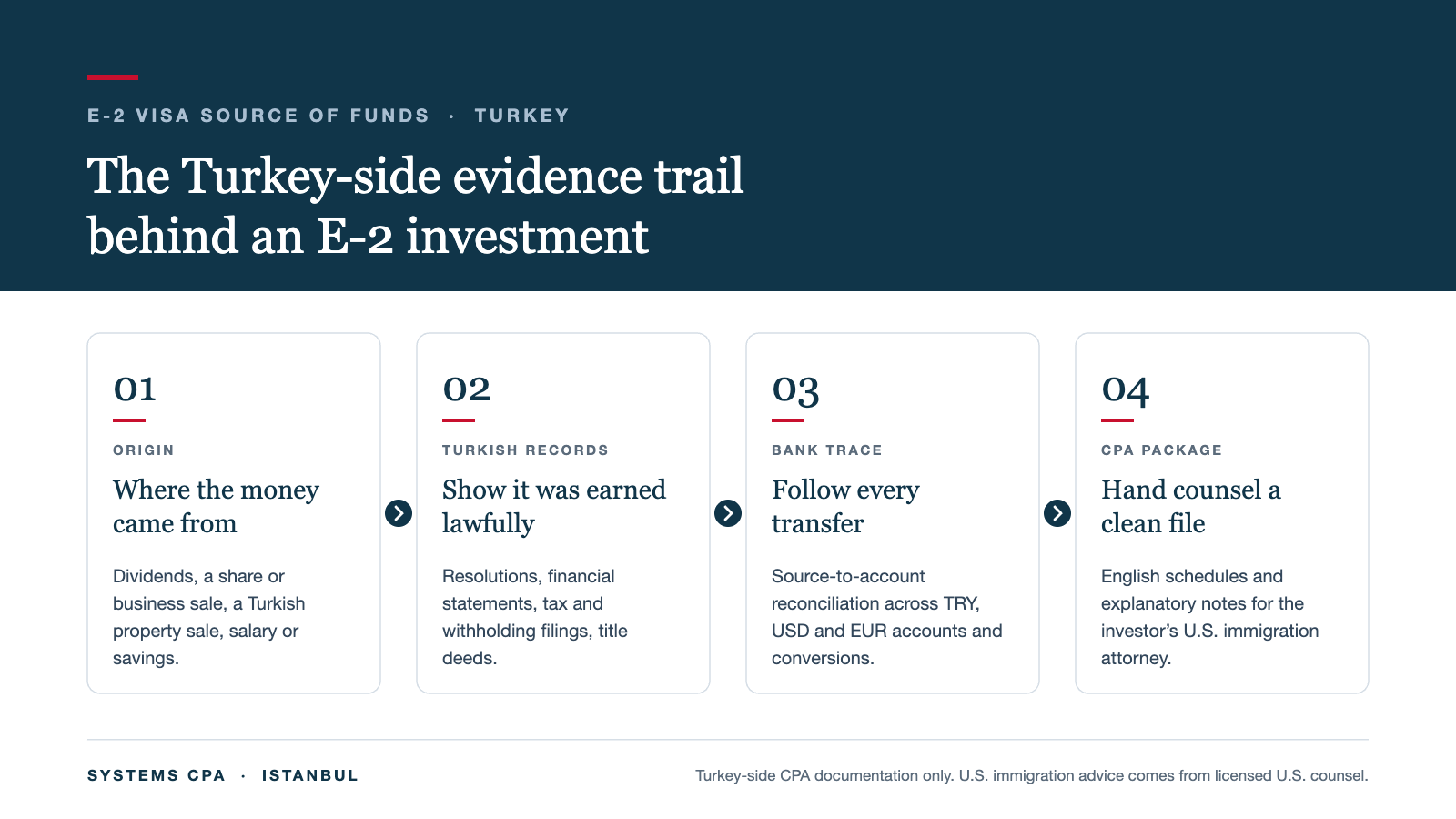
E-2 visa source of funds Turkey: key facts
| Question | Short answer |
|---|---|
| Is Turkey an E-2 treaty country? | Yes. The U.S. Department of State lists Turkey’s E-2 treaty investor status as in force since 18 May 1990 (E-1 treaty trader since 15 February 1933). |
| What must the source of funds evidence show? | That the investor acquired the funds lawfully, possesses and controls them, and has committed them to the U.S. enterprise (9 FAM 402.9). |
| Do borrowed funds count? | Under 9 FAM 402.9, loans secured by the investor’s own assets, such as a Turkish property, may count; loans secured by the assets of the U.S. enterprise do not. |
| Who decides what is filed? | The investor’s U.S. immigration attorney. A Turkish CPA supplies the Turkey-side records, reconciliations and English explanations. |
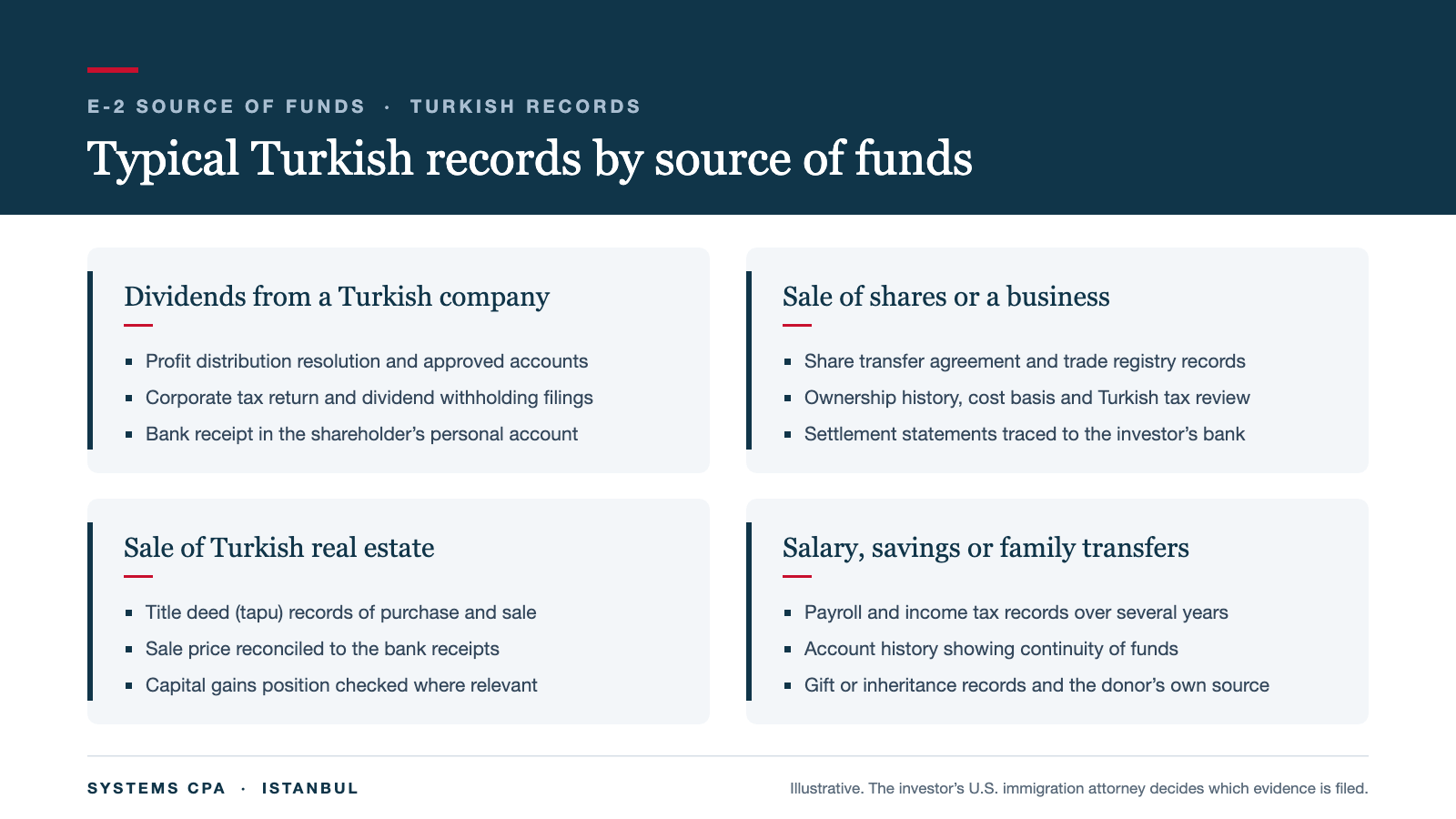
| Typical Turkish records | Dividend resolutions, approved financial statements, corporate and withholding tax filings, share-transfer and trade-registry records, title deeds (tapu) and bank statements. |
| Outside our scope | U.S. immigration advice, visa filings and U.S. tax returns, which belong with licensed U.S. advisers. |
When our team is useful
- Turkish company dividends: distributable profits, corporate resolutions, accounting records, withholding treatment, shareholder receipts and bank tracing.
- Business or share sale: purchase and sale agreements, ownership history, accounting entries, settlement statements and source-to-bank reconciliation.
- Real estate sale: Turkish title and sale records, bank receipts, transaction timing and tax review where relevant.
- Personal savings or family transfers: account statements, income history, donation/inheritance records and continuity of funds.
- Mixed sources: document mapping where more than one funding source must be explained accurately.
Three engagement options
1. Source-of-Funds Readiness Review
A preliminary assessment of the capital origin and the documents already available. Deliverable: an evidence-gap list, a transaction timeline and a scoped document request. This does not confirm U.S. visa eligibility.
2. Turkey Financial Documentation Package
After engagement and secure document collection, we prepare source-of-funds schedules, bank movement reconciliations, explanatory accounting notes and supporting Turkish tax/company records, as applicable. Certified translations, legalization and foreign-law opinions are separately scoped if needed.
3. Turkish Pre-Investment Tax Review
We assess the Turkey-side consequences and timing of dividend distributions, share or asset disposals, potential residence changes and other relevant tax matters before the investor uses those proceeds for a U.S. business. U.S. federal and state tax work requires appropriately qualified U.S. advisers.
Documents we commonly examine
- Identity and ownership structure of the investor and the relevant Turkish entity (initially only an outline, not personal identification documents).
- Commercial registration records, shareholder ledgers, resolutions, annual financial statements and relevant tax returns.
- Transaction contracts, dividend distribution decisions or property-transfer documents.
- Bank statements tracing receipt, currency conversion and outgoing transfers, including intermediary accounts.
- Existing U.S. investment agreements and attorney-provided document requests, as appropriate.
Common E-2 source of funds mistakes with Turkish money
- Treating company cash as personal money. A Turkish company’s bank balance belongs to the company until a distribution is resolved, taxed and paid to the shareholder.
- Gaps in the bank trail. Cash deposits, exchange-office conversions or transfers through relatives’ accounts need receipts and a dated reconciliation.
- A title-deed value that does not match the money received. A mismatch between the tapu record and the sale proceeds raises questions in the U.S. file and under Turkish tax rules; review it before relying on the proceeds.
- Moving funds before the Turkish tax step is closed. Dividend withholding, gains on shares or property and residence-change questions should be settled before the money leaves Turkey.
- Undocumented gifts or family loans. A gift letter alone is rarely enough; the donor’s own lawful source usually has to be shown as well.
Illustrative example: dividends from a Turkish company
A founder proposes to invest USD 200,000 in a U.S. operating business. The intended source is accumulated profits of a Turkish company. The company’s bank balance alone does not establish that the founder personally owns and controls the investment funds. Our first task is to verify distributable profit, the legally documented distribution, relevant Turkish tax and withholding treatment, receipt by the shareholder, and the trail from that receipt to the proposed U.S. investment. The amount is illustrative, not an E-2 minimum or a representation that the investment will qualify.
For Turkish dividend basics, see our dividend distribution and taxation guide; for profit movements, see our profit repatriation guide. The investor’s tax position can differ from that of a non-resident corporate shareholder.
E-2 financial documentation is not the same as visa eligibility
Under U.S. State Department guidance, an E-2 case involves a qualifying treaty nationality, a substantial qualifying investment, funds genuinely at risk, a real operating enterprise, and the investor’s ability to develop and direct it, among other requirements. There is no universal statutory dollar minimum. A well-prepared financial trail supports evidence quality but does not substitute for a U.S. immigration lawyer’s eligibility analysis or guarantee a visa.
For U.S. immigration attorneys
We can act as your dedicated Turkey-side financial and tax documentation contact. We scope the Turkish question, agree confidentiality and conflicts before receiving sensitive records, and provide clear English-language schedules or explanatory notes. See our support for international law firms.
Practical E-2 guides from our team
- E-2 source-of-funds financial document checklist
- Using dividends from a Turkish company for an E-2 investment
- Pre-departure tax planning when moving from Turkey to the USA
- Support for U.S. immigration attorneys
Frequently asked questions
Is there a fixed E-2 minimum investment?
No universal fixed dollar amount is prescribed. U.S. officials apply a proportionality assessment and other eligibility criteria to the specific enterprise.
Does a bank balance alone prove the source of funds?
Not necessarily. A credible evidence package may need to establish how money was earned or received, who controlled it, and how it moved to the investment.
Can Turkish company profits be used?
Potentially, but company funds and a shareholder’s personal funds are not automatically interchangeable. A lawful distribution, tax treatment, ownership and the transaction trail require individual analysis with U.S. counsel.
Do you file E-2 visa applications?
No. Our service concerns Turkey-side accounting, financial documents and Turkish taxation. Immigration strategy and applications belong with licensed U.S. immigration counsel.
What happens if part of the money passed through cash or an exchange office?
It can still be explained, but only with receipts, bank records and a dated reconciliation that links each conversion back to the original source. Unexplained cash weakens an E-2 source of funds narrative quickly, so we map those steps first.
What happens if the funds come from more than one source?
Each source is documented on its own and then combined in a single schedule, so the amount invested in the U.S. business ties back to identifiable, lawful origins. Turkish founders often combine dividends, a property sale and personal savings.
How should I start?
Contact us with the origin of your proposed funds, approximate amount, intended investment timing and whether your U.S. attorney has provided a document checklist. Please do not email confidential tax returns, passports or full bank statements before a secure process is agreed.
Request a scoped E-2 financial documentation review
Tell us the origin of the investment funds, your timeline and whether U.S. immigration counsel is already appointed. We respond with an engagement scope; please do not send confidential documents in the first email.
Email our Turkish CPA teamAsk on WhatsAppPrimary authorities and related reading
- U.S. Department of State — 9 FAM 402.9 (E-2 requirements, source and control of funds, suggested evidence).
- IRS — Substantial Presence Test (separate U.S. tax-residency analysis).
- Our editorial and verification standards.
- U.S. Department of State — Treaty Countries (Turkey: E-2 treaty investor status in force since 18 May 1990).
“They are definitely the best accountant in Turkey for international business owners. They handle everything.”
“Finding a trustworthy, English-speaking CPA in Istanbul felt overwhelming at first — until I met Evren and his team.”
“Working with Evren has been the best decision for my business in Turkey.”