
Tax Certainty · Industrial registry · Updated for SGM 2026/4 and Law No. 7582
An industrial registry certificate (sanayi sicil belgesi) is the Ministry of Industry and Technology’s record that your site in Turkey actually produces. Since April 2026 it is issued after a site inspection and stays valid only while you file the annual operating statement, and from 2027 it decides whether production profit is taxed at 12.5% or 25%.
Summarise this page with: ChatGPT Claude Perplexity Grok Google AI Mode
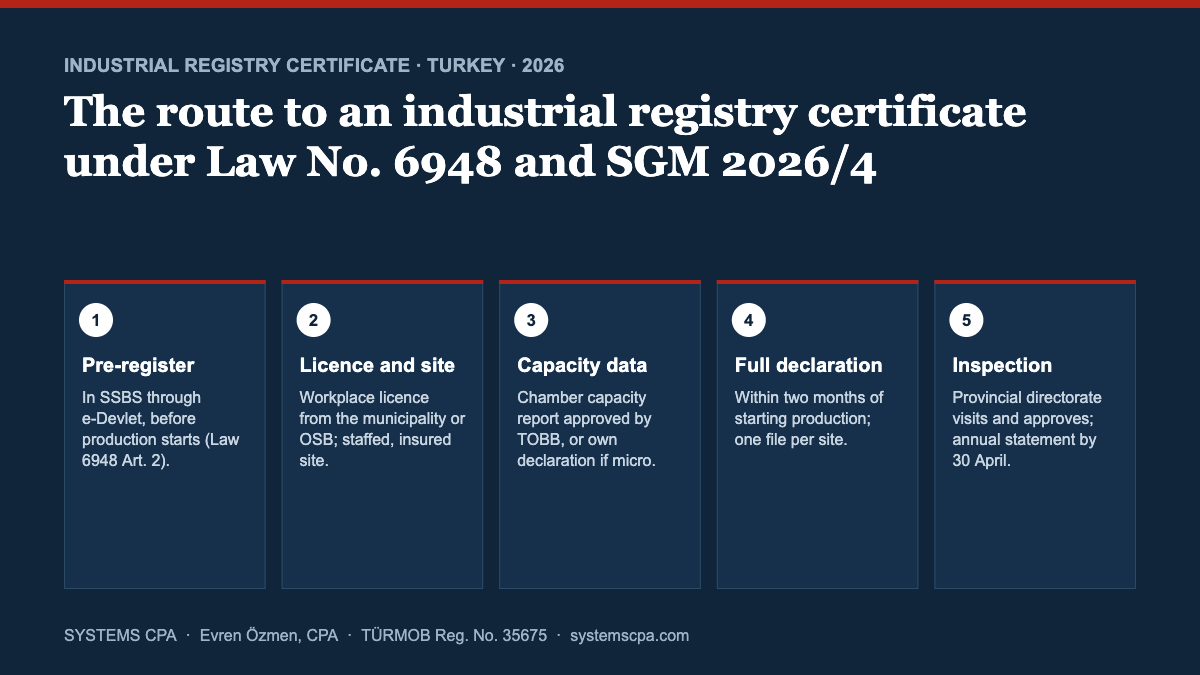
Apply online in SSBS, the Ministry of Industry and Technology’s Industrial Registry Information System, after logging in through e-Devlet. Each production site needs its own application. Pre-register before production starts, file the full declaration within two months of starting, add capacity data from a chamber capacity report (micro enterprises may declare their own), and pass the provincial directorate’s site inspection.
Prefer to hand the file over? Describe your site and products and a CPA will tell you whether you qualify, what the inspector will look at and how the certificate changes your 2027 corporate tax rate.
Industrial registry certificate: key facts for 2026
| Question | Position on 27 October 2026 | Legal basis |
|---|---|---|
| What it is | The Ministry of Industry and Technology’s record that a site in Turkey is an industrial enterprise, with its products, machinery and capacity | Law No. 6948, Arts. 1–3 |
| Who must register | Enterprises that produce continuously and serially; serial repairers; energy plants; large yards; IT and software producers | Law No. 6948, Art. 1(1)–(2) |
| Who is outside | Hand and home crafts and small repair shops, unless the Ministry designates them; pure traders | Law No. 6948, Art. 1(3) |
| When | Pre-registration before production starts; full declaration within two months of starting activity | Law No. 6948, Art. 2 |
| Where | SSBS (sanayisicil.sanayi.gov.tr), entered through e-Devlet | SGM 2026/4, Art. 10(1) |
| Unit of registration | One application per production site | SGM 2026/4, Art. 4(2) |
| Capacity data | Chamber capacity report for small, medium and large firms; own declaration for micro firms without a report | SGM 2026/4, Art. 10(4) |
| Approval | Provincial Directorate of Industry and Technology, after a site inspection | SGM 2026/4, Arts. 3 and 5(1) |
| Validity | Two-year visa abolished from 15 April 2026; validity now follows the annual operating statement | SGM 2026/4, Art. 7 |
| Yearly duty | Annual operating statement within four months of year end (30 April) | Law No. 6948, Art. 5 |
| Changes | Notify within one month | Law No. 6948, Art. 4 |
| Fine for a missed duty (2026) | TRY 15,029 per breach | Law No. 6948, Art. 9 (revalued yearly) |
| Tax link | Production profit taxed at 12.5% from 2027; 24% (one-point cut) in 2026 | Corporate Tax Law Art. 32(8), as amended by Law No. 7582 |
- The industrial registry certificate (sanayi sicil belgesi) records that a specific site in Turkey actually produces. It is not a licence to operate; the workplace licence is a separate document.
- Manufacturers, serial repairers, energy plants, large yards and, since 2017, IT and software producers are in scope. Traders and brand owners who outsource all production are not.
- Since 15 April 2026 the two-year visa is gone. The certificate stays valid only while you file the annual operating statement by 30 April.
- From 2027 a valid industrial registry certificate is a condition for taxing production profit at 12.5% instead of 25%.
- Each missed registration, change notice or annual statement costs TRY 15,029 in 2026, and a lapsed certificate puts the reduced rate at risk.
1. What is an industrial registry certificate (sanayi sicil belgesi)?
The industrial registry certificate is the extract issued from the industrial registry that the Ministry of Industry and Technology has kept under Law No. 6948 since 1957. The register records who produces what, where, with which machinery and at what capacity (Law No. 6948, Art. 3). Companies show the certificate to tax offices, chambers, banks, energy suppliers, customers and procurement bodies as proof of industrial status.
You will see several English names for the same Turkish document: industrial registry certificate, industrial registration certificate and industrial record certificate. The yearly filing that keeps it alive, the yıllık işletme cetveli, is usually translated as the annual operating statement and sometimes as the annual business chart.
No. The workplace opening and operating licence (işyeri açma ve çalışma ruhsatı) comes from the municipality or the organised industrial zone and allows you to use the premises for the activity. The industrial registry certificate comes from the Ministry of Industry and Technology and records that you produce there. Law No. 6948, Art. 2 links the two: the licensing authority asks for proof of registry.
Industrial registry certificate vs workplace licence
| Industrial registry certificate | Workplace opening and operating licence | |
|---|---|---|
| Issued by | Provincial Directorate of Industry and Technology | Municipality, or the OSB directorate inside an organised industrial zone |
| What it proves | The site is a registered industrial enterprise with recorded products, machinery and capacity | The premises may be used for the stated activity |
| Legal basis | Law No. 6948; Industrial Registry Communiqué SGM 2026/4 | 2005 Regulation on Workplace Opening and Operating Licences |
| Kept alive by | Annual operating statement by 30 April | Re-issued when the activity, operator or premises change |
| Tax relevance | Condition for the reduced corporate tax rate on production profit | None directly |
2. Who needs an industrial registry certificate, and who cannot get one
Registration is compulsory for businesses inside the scope of Law No. 6948. Article 1(1) defines an industrial enterprise as a place that continuously and serially manufactures or produces by changing the quality, form or composition of materials, whether with machines, devices, tools or by hand; mining sites that extract and process ore are included. Article 1(2) adds serial repair establishments, electricity and other energy plants, large construction yards such as shipyards and, since Law No. 7033 of 2017, enterprises that produce information technology and software. Article 1(3) leaves out hand and home crafts and small repair shops unless the Ministry designates them.
| Your activity | Registrable? | What decides it |
|---|---|---|
| Manufacturing in your own plant | Yes, compulsory | Serial production at the site, with machinery and capacity recorded |
| Assembling systems from purchased components | Usually yes | Whether assembly is serial production at your site rather than one-off installation at customer premises |
| Software or AI products developed in Turkey | Yes, since 2017 | Software production at a declared site, with the software defined as the product |
| Contract manufacturing for a brand owner | Yes, for the producer | The producer’s own site, machinery and capacity |
| Brand owner outsourcing all production | No | There is no production site of its own to register |
| Import, distribution and trading | No | Buying and reselling is not industrial activity |
| Serial repair and maintenance | Yes | Serial repair establishments are named in Art. 1(2); small repair shops are excluded |
| Recycling with sorting-and-pressing or crushing lines | Often yes | The Ministry has accepted facilities with processing machinery |
| Hand crafts and home production | No, unless designated | Art. 1(3) exclusion |
Size does not take a business out of scope. Micro enterprises register too; they may declare their capacity themselves instead of obtaining a chamber capacity report (SGM 2026/4, Art. 10(4)). Ownership does not matter either: a foreign-owned Turkish company registers exactly like a Turkish-owned one.
The question foreign-owned groups ask first is rarely “how do we register?” It is “are we a manufacturer at all?” The test is the site, not the group’s self-image. A Turkish subsidiary that only imports and sells the parent’s products is a trader, however industrial the parent is. A ten-person Istanbul team building production software for factories, on the other hand, can sit squarely inside Law No. 6948.
3. Why the industrial registry certificate matters more from 2027
Until this year the certificate was mainly a compliance item. Law No. 7582 (Official Gazette 4 June 2026, No. 33270) changed its weight. Article 8 of that law rewrote Article 32(8) of the Corporate Tax Law No. 5520: for periods starting in 2027, profit from production activity of corporations that hold an industrial registry certificate and actually produce is taxed at 12.5% instead of the standard 25%. For 2026, the existing one-point reduction continues, so qualifying production profit is taxed at 24%.
Corporations, not sole proprietors, that hold an industrial registry certificate and are actually engaged in production, and only on the profit that comes from that production. Trading margins, interest, FX gains and other non-production income stay at 25%. The 12.5% rate cannot be combined with the five-point export reduction on the same profit, and it is first applied in the 2027 advance tax periods.
The Corporate Tax General Communiqué amendment No. 26 (Official Gazette 4 July 2026, No. 33300) explains how the reduced-rate base is found. In outline, taxable income is multiplied by the share of production profit in total commercial profit; outsourced production counts only under narrow conditions; and software and IT production within the scope of the certificate qualifies. The safe working assumption for timing is simple: hold a valid industrial registry certificate before 1 January 2027 and keep it valid all year. We set out the timing rules, and the open questions, in our guide to the industrial registry deadline for the 2027 rate; the rate mechanics are covered in 12.5% manufacturing corporate tax in Turkey.
The domestic minimum corporate tax does not undo the saving. Under Corporate Tax Law Art. 32/C(3), the tax not collected because of the reduced production rate is deducted when the 10% floor is computed, so paying 12.5% on production profit does not by itself trigger a top-up to the floor. Loss carry-forwards and investment-incentive certificates issued after 2 August 2024 can still bring the floor into play.
Two caveats for groups. Multinationals inside Turkey’s global minimum tax rules (Law No. 7524) may see a top-up tax absorb part of the saving. And the law’s wording (the rate “is applied as 12.5%”) differs from the communiqué’s description of a 12.5-point reduction; the difference is harmless today but matters if the general rate or other reductions change. Both belong in a 2027 forecast.
4. How to apply for an industrial registry certificate, step by step
Every transaction runs through SSBS after an e-Devlet login (SGM 2026/4, Art. 10(1)). The communiqué replaced the 2014 rules on 15 April 2026, so guidance older than that, and especially anything that mentions a two-year visa, is out of date.
- Define the activity and the products. Describe what the site produces in the terms of the industrial products classification SSBS uses. Vague product lists are the most common reason an inspector comes back with questions.
- Make the site real. A lease or title in the company’s name, chamber membership, SGK workplace registration and insured staff. The directorate looks for an operating site, not an address.
- Pre-register before production starts. Law No. 6948, Art. 2 requires a pre-registration (ön kayıt) before production begins, and the authority issuing the workplace licence asks for it.
- Obtain the workplace opening and operating licence from the municipality or the OSB directorate, together with any environmental permit your activity needs.
- Obtain the capacity data. Small, medium and large enterprises use a chamber capacity report approved by TOBB; micro enterprises without a report may declare their capacity (SGM 2026/4, Art. 10(4)).
- File the full declaration within two months of starting production (Law No. 6948, Art. 2): site, machinery, products, capacity and employees, with the documents uploaded. One application per production site (SGM 2026/4, Art. 4(2)).
- Pass the inspection. The Provincial Directorate of Industry and Technology inspects the site and approves, or rejects with reasons, after which you can reapply (SGM 2026/4, Arts. 5(1) and 10(2)).
- Receive the certificate and diarise the duties. The certificate date is the date the complete application was sent for approval (SGM 2026/4, Art. 5(3)). From then on: changes within one month, annual operating statement by 30 April.
If your investment is essentially complete and production waits only for raw materials, Article 9 of the communiqué allows the directorate to issue a letter confirming that you will be registered as soon as production starts. That letter is useful in incentive and financing files.
5. What to prepare before you log in to SSBS
SSBS collects information field by field rather than publishing one fixed document list, and the inspector may ask for more. This is the working checklist we use for an industrial registry certificate file:
| Item | Why it is needed | Typical source |
|---|---|---|
| e-Devlet access for the authorised signatory | Every SSBS transaction requires an e-Devlet login | Authorised manager; a foreign manager needs a Turkish ID number and e-Devlet password |
| Company registration data | Links the registry record to the legal entity | Trade registry gazette, MERSİS, chamber registration |
| Site evidence | Registration is per production site | Lease or title deed, site plan, door number |
| Workplace licence, or pre-registration to obtain it | Licensing and registry are linked by Law No. 6948, Art. 2 | Municipality or OSB directorate |
| Machinery list | The register records machinery (Art. 3) | Fixed asset register, invoices, power ratings |
| Products and annual capacity | The core of the declaration | Chamber capacity report, or micro-enterprise declaration |
| Employees | The inspector checks that the site is staffed | SGK workplace registration and payroll |
| Environmental documents, where relevant | Some activities need an EIA decision or environmental permit | Ministry of Environment, Urbanisation and Climate Change |
The documents that slow a file down are rarely the ones the Ministry issues. They are the ones other offices issue: the workplace licence, the capacity report, an environmental permit. Start those first. Once the machinery and product data are clean, the SSBS declaration itself is a short piece of work.
6. How long does an industrial registry certificate take?
Neither Law No. 6948 nor SGM 2026/4 sets a processing deadline for the Ministry. Time is consumed by the documents that come before the application and by the inspection diary.
| Stage | What sets the pace | Planning note |
|---|---|---|
| Capacity report | Chamber expert visit and TOBB review | Practitioners report that TOBB’s 2025 principles give the chamber one month to issue and TOBB one month to review |
| Workplace licence | Municipality or OSB; zoning and fire checks | Often the longest item for a new building |
| SSBS declaration | The quality of your machinery and product data | Short once the data is ready |
| Inspection and approval | The provincial directorate’s schedule | Inspection is the norm since April 2026, so plan for a visit |
There is no statutory deadline. Once the capacity report and the workplace licence exist, the SSBS filing itself is short and the inspection date becomes the main variable. Starting from scratch, the capacity report (chamber visit plus TOBB review) and the workplace licence usually take longer than the registry step, so they should be started first.
7. What drives the cost of an industrial registry certificate
The official charges are modest. The real cost is getting the site, the licences and the data ready.
| Cost driver | What it depends on | 2026 reference |
|---|---|---|
| Ministry service fee for first registration | Fixed tariff | TRY 500 under the Ministry’s 2026 service-fee tariff |
| Capacity report | Chamber fee banded by capital or headcount, plus a TOBB approval fee | 2026 chamber tariffs list a TOBB approval fee of TRY 8,500; chamber fees vary |
| Site readiness | Lease, fit-out, separation from other companies at the same address | Your premises |
| Workplace licence and permits | Building use permit, fire report, environmental permit | Municipal and environmental charges |
| Data preparation | Machinery records, product classification, capacity calculations | Internal time or professional support |
| Ongoing compliance | Annual operating statement, change notices, tax segmentation of production profit | Recurring each year |
Professional support is scoped after we have seen the site, the product list and the ownership structure; fees are confirmed privately before any work starts.
8. Keeping the industrial registry certificate valid
SGM 2026/4 abolished the two-year visa. Under its Article 7, a newly registered enterprise’s certificate is valid until the end of the following year’s annual-statement window, so a certificate issued in 2026 runs to 30 April 2027, and each annual operating statement extends validity for another year. A certificate whose holder does not file is renewed only once the statement is filed, and Article 7(6) provides that only a certificate with current validity confers rights and exemptions.
| Duty | Deadline | Legal basis | Fine if missed (2026) |
|---|---|---|---|
| Pre-registration | Before production starts | Law No. 6948, Art. 2 | TRY 15,029 |
| Full registration declaration | Within two months of starting activity | Law No. 6948, Art. 2 | TRY 15,029 |
| Change notice (title, address, products, machinery, closure, reopening) | Within one month | Law No. 6948, Art. 4 | TRY 15,029 |
| Annual operating statement | Within four months of year end (30 April) | Law No. 6948, Art. 5 | TRY 15,029 |
| Showing the certificate to officials | On request | Law No. 6948, Art. 10 | Base amount TRY 250, revalued yearly |
| Giving false information | — | Law No. 6948, Art. 11 | Base amount TRY 1,000, revalued yearly |
Fines are imposed by the district governor or provincial governor (Art. 11(2)) and revalued each year in line with the revaluation rate. The TRY 15,029 figure is the amount the Ministry announced for 2026. Our guide to industrial registry renewal and the annual operating statement covers filing, late filing and transitional rules for older certificates.
9. Capacity report vs industrial registry certificate
| Capacity report | Industrial registry certificate | |
|---|---|---|
| Issued by | Your chamber of industry, or of commerce and industry, approved by TOBB | Ministry of Industry and Technology, through the provincial directorate |
| What it states | Annual production capacity of your machinery and workforce | That the site is a registered industrial enterprise |
| Validity | Up to two years under TOBB’s 2025 principles; ends early on relocation, transfer or capacity change | Follows the annual operating statement since April 2026 |
| Used for | The registry declaration for non-micro firms, the Domestic Goods Certificate, many incentive files | The reduced corporate tax rate, the Domestic Goods Certificate, compliance |
One feeds the other: for small, medium and large enterprises, the capacity data in SSBS comes from the capacity report. See capacity report vs industrial registry certificate for the chamber process.
10. Software and AI producers
Since Law No. 7033 (2017), Article 1(2) of Law No. 6948 expressly covers enterprises that produce information technology and software. SGM 2026/4 goes further: where several companies share an address, the usual requirements for physically separated space and separate capacity reports do not apply to software activities (Art. 5(5)). Communiqué No. 26 confirms that software and IT production within the scope of the certificate can use the reduced rate. What remains open is classification. Licensed software you produce is the clearest case; hosted subscriptions and custom projects mix production with services and need a documented position. Our guide to software production and the industrial registry certificate goes through it.
11. Contract manufacturing
The industrial registry follows the site. A contract manufacturer registers its own plant; a brand owner that outsources everything has no site to register and no production profit for the reduced rate. Communiqué No. 26 lets a certificate holder count outsourced output only if it is within the certificate’s scope, the company’s own production is the larger part, the volume stays within its capacity, and the company supplies the raw materials and carries the risk. Details are in contract manufacturing and the industrial registry certificate.
12. Other uses of the certificate
A valid industrial registry certificate, together with a valid capacity report for the same address, is a precondition for the chambers’ Domestic Goods Certificate (yerli malı belgesi), which public procurement uses for the domestic price advantage; the product needs at least 51% local content and the Domestic Goods Certificate is valid for one year. Banks, customers’ supplier audits and organised industrial zones also ask for the registry certificate. The full list, with the legal basis for each item, is in industrial registry benefits in Turkey.
13. Turkey vs other manufacturing locations
Foreign groups often compare Turkey with the Gulf, North Africa and Central Europe. The registration logic differs as much as the tax rate:
| Country | Registration that matters | Issued by | Tax relief linked to manufacturing |
|---|---|---|---|
| Turkey | Industrial registry certificate, compulsory for industrial enterprises | Ministry of Industry and Technology, after a site inspection | 12.5% on production profit from 2027 (24% in 2026) with a valid certificate |
| United Arab Emirates | Industrial licence, plus MoIAT industrial production licence and industrial registry | Local or free-zone licensing authority; MoIAT | 9% corporate tax (0% up to AED 375,000); 0% on qualifying income of Qualifying Free Zone Persons; customs exemptions for licensed producers |
| Saudi Arabia | Industrial licence in three stages: establishment, construction, production | Ministry of Industry and Mineral Resources | 20% corporate tax on the foreign share; 5% for 20 years on qualifying income in special economic zones |
| Egypt | Operating licence and Industrial Register entry | Industrial Development Authority | 22.5% corporate tax; investment-cost deductions under Investment Law 72/2017; partial tax refunds for qualifying industrial projects under Law 160/2023 |
| Poland | No national industrial registry; environmental, building and integrated permits | Local and environmental authorities | 19% corporate tax; Polish Investment Zone exemption for 12–15 years |
| Romania | No separate industrial registry; Trade Register self-declaration and environmental permit with annual visa | ONRC; environmental agencies | 16% corporate tax; industrial park property-tax exemptions; reinvested-profit exemption |
Summarised from official sources and Big Four tax summaries as of October 2026. Zone-specific conditions apply in every country listed.
Turkey is unusual in tying a headline corporate tax rate to a registry entry. Elsewhere the industrial registration is a licence; here it is also a tax document. That is why it now belongs on the CFO’s desk and not only the plant manager’s.
14. Case analyses
Case 1: AI quality-control systems developer in Maslak, Istanbul
Based on a recent enquiry; anonymised.
- Facts
- The company develops AI-based visual inspection software for production lines. Its team works in an office in Maslak; it buys cameras and lighting and configures them for each customer. It asked about requirements, process, documents, timeline and fees for an industrial registry certificate.
- The obvious answer
- Either “you are a software company with an office, the certificate is for factories”, or the opposite: “register the office and apply 12.5% to everything”.
- Why both fail
- Software producers have been inside Law No. 6948 since 2017, so the first answer leaves a 2027 rate cut on the table. The second fails because the reduced rate attaches only to production profit within the certificate’s scope; camera resale, on-site installation and support contracts are not production at the declared site.
- The structure we would recommend
- Register the Maslak office as a software production site with the inspection software defined as the product; treat hardware resale and installation as separate revenue lines; build the production-profit ratio into the chart of accounts from January 2027; document how licence and subscription revenue is earned before applying the rate; and compare the result with the technopark exemption and the service-export deduction for foreign customers.
Case 2: foreign-owned components maker with two plants
Illustrative; details changed.
- Facts
- A German-owned company holds a certificate for its Gebze plant, obtained years ago. It opened a second plant in Manisa in 2025.
- The obvious answer
- “The company has a certificate, so all production profit qualifies in 2027.”
- Why it fails
- Registration is per production site (SGM 2026/4, Art. 4(2)). Manisa has no certificate, so its profit has no claim to the reduced rate, and the company has been in breach of the registration duty since Manisa started production.
- The structure adopted
- Register Manisa now, accepting the late-registration fine, which is small against the rate gap; confirm Gebze’s validity under the new Article 7 rules; and split production profit by site in the 2027 ledger.
Case 3: brand owner using a contract manufacturer
Illustrative; details changed.
- Facts
- The Turkish subsidiary of a cosmetics brand designs formulas and packaging in-house; all filling is done by a contract manufacturer in Tuzla.
- The obvious answer
- “We own the product, so we are the manufacturer and qualify for 12.5%.”
- Why it fails
- The subsidiary has no production site of its own, so there is nothing to register; the contract manufacturer holds the certificate. Communiqué No. 26 lets outsourced output count only when the certificate holder’s own production is the larger part.
- The options we model
- Stay a trading company at 25% and price the supply contract properly, or bring a filling line in-house, sized so that own production exceeds outsourced volume, register that site and apply the reduced rate only to qualifying profit. It is a capital-expenditure decision, not a paperwork one.
15. What happens if…
What happens if we started producing without an industrial registry certificate?
Register now. Late registration is fined under Article 9 of Law No. 6948 (TRY 15,029 in 2026), but every period without a certificate is a period in which production profit has no claim to the reduced rate. The fine is the cheap part.
What happens if we miss the 30 April annual operating statement?
The late filing is fined and validity lapses until you file; under Article 7(6) of SGM 2026/4 a certificate without current validity confers no rights. How a lapse interacts with the 12.5% rate for the months concerned is not settled, so treat 30 April as a tax deadline, not an administrative one.
What happens if we move the factory?
Notify the change within one month (Law No. 6948, Art. 4). A relocation normally ends the capacity report’s validity, so plan a new report. An address change reissues the certificate with the same number and date (SGM 2026/4, Art. 6).
What happens if the company is sold, merged or converted?
A transfer, merger, division or change of company type produces a new certificate number and date (SGM 2026/4, Art. 6). Because the certificate date can matter for tax periods, schedule restructurings with the registry in mind.
What happens if the inspector finds no production yet?
The application is rejected with reasons and you can reapply. If the investment is largely complete and only raw-material supply is missing, ask for the Article 9 letter instead.
16. Five mistakes we see in industrial registry files
- Registering the head office instead of the production site, or one site for several plants.
- Copying product descriptions from the articles of association instead of describing what the machines actually make.
- Treating the capacity report as permanent. It expires, and it lapses on relocation or a change in capacity.
- Missing the annual operating statement because nobody owns it after the plant manager changes.
- Applying the reduced rate to all profit, including trading margins, interest and FX gains.
Start your industrial registry certificate file
Tell us what you produce and where. A CPA reviews eligibility, the capacity-data route and the 2027 tax effect together, or see how our industrial registry application service works.
Send these six details and we can scope the file in one reply:
- Company name and ownership (Turkish company, foreign shareholder, group).
- Production site address, or addresses if there is more than one.
- What the site produces, assembles or develops.
- Whether production has already started, and since when.
- Status of the capacity report and the workplace licence.
- Why you need the certificate (2027 rate, incentive, tender, customer) and your timeline.
Email the six details WhatsApp a CPA Call +90 216 352 29 61
Reviewed by a licensed Turkish CPA (TÜRMOB Reg. No. 35675). We reply in English, usually within one business day. Engagements begin with a scoping consultation; fees are confirmed privately before any work starts.
Frequently asked questions
What is “sanayi sicil belgesi” in English?
It is the industrial registry certificate, sometimes translated as the industrial registration certificate. It is issued from the industrial registry kept by the Ministry of Industry and Technology under Law No. 6948.
Is the industrial registry certificate mandatory in Turkey?
Yes, for enterprises within the scope of Law No. 6948. Pre-registration is required before production starts and the full declaration within two months of starting activity (Art. 2). Each missed duty is fined TRY 15,029 in 2026.
Can a foreign-owned company get an industrial registry certificate?
Yes. Ownership is irrelevant. The Turkish company that operates the production site applies through SSBS; its authorised signatory needs e-Devlet access, which a foreign manager obtains with a Turkish ID number.
Does the industrial registry certificate expire?
There is no longer a two-year visa. Since 15 April 2026 validity runs to the end of the next annual-statement window and is extended each time the annual operating statement is filed (SGM 2026/4, Art. 7).
How much does an industrial registry certificate cost?
The Ministry service fee for first registration is TRY 500 under the 2026 tariff. A chamber capacity report adds a chamber fee and a TOBB approval fee. The larger costs are site readiness, licences and data preparation.
Can a software company get an industrial registry certificate?
Yes. Since Law No. 7033 (2017), enterprises that produce information technology and software are expressly within Law No. 6948, and communiqué No. 26 lets software production within the certificate’s scope use the reduced corporate tax rate.
Do we need a capacity report?
Small, medium and large enterprises provide capacity data from a chamber capacity report approved by TOBB. Micro enterprises without a report may declare their capacity themselves (SGM 2026/4, Art. 10(4)).
Do we need the certificate before 2027 to use the 12.5% rate?
Plan on yes. The rate applies to corporations that hold the certificate and actually produce, and only a currently valid certificate confers rights (SGM 2026/4, Art. 7(6)). Holding a valid certificate before 1 January 2027 and keeping it valid all year avoids any argument.
Can a sole proprietorship use the 12.5% rate?
No. The reduced rate is in the Corporate Tax Law and applies to corporations. A sole proprietor can still be registered in the industrial registry where the activity is within scope.
Can we combine the 12.5% rate with the export reduction?
Not on the same profit. Production profit taxed at the reduced rate cannot also use the five-point export reduction.
Primary sources
- Law No. 6948 on the Industrial Registry (Sanayi Sicili Kanunu), consolidated text — mevzuat.gov.tr
- Industrial Registry Communiqué SGM 2026/4, Official Gazette 1 April 2026, No. 33211 — resmigazete.gov.tr
- Law No. 7582, Official Gazette 4 June 2026, No. 33270 (Art. 8 amending Corporate Tax Law Art. 32) — resmigazete.gov.tr
- Corporate Tax General Communiqué amendment No. 26, Official Gazette 4 July 2026, No. 33300 — resmigazete.gov.tr
- Corporate Tax Law No. 5520, consolidated text — mevzuat.gov.tr
- Law No. 7033, Official Gazette 1 July 2017, No. 30111 (software producers added to Law No. 6948) — resmigazete.gov.tr
- Revenue Administration (GİB), corporate tax legislation and communiqués — gib.gov.tr
- Industrial Registry Information System (SSBS) — Ministry of Industry and Technology
- e-Devlet: industrial registry transactions — turkiye.gov.tr
Related guides in this series
Industrial Registry Application Service
We prepare, file and keep your certificate valid, with the tax side handled by a CPA.
Industrial Registry Deadline for the 2027 12.5% Rate
When the certificate has to exist for 2027 production profit to qualify.
Software Production and the Industrial Registry Certificate
Why AI and software producers are in scope, and what the inspection looks for.
Industrial Registry Renewal and the Annual Business Chart
The vize is gone; the 30 April filing now decides whether the certificate is valid.
Capacity Report vs Industrial Registry Certificate
What each document proves, who issues it and which one comes first.
Contract Manufacturing and the Industrial Registry Certificate
Who can register and who gets the reduced rate when production is outsourced.
Industrial Registry Benefits in Turkey
Tax, energy, public tenders and incentives that depend on the certificate.
Opening a Factory in Turkey: Licences in the Right Order
Company, site, licence, capacity report, registry and incentives in sequence.
Turn Turkey compliance into certainty
SYSTEMS CPA supports foreign-owned companies with company formation, accounting, tax compliance and payroll in Turkey — one accountable local partner. Reviewed by Evren Özmen, SMMM (Certified Public Accountant), TÜRMOB Reg. No. 35675.
