
Peace of Mind · Accounting takeover · Year-end cut-over · Law No. 3568
Best Time to Change Accountants in Turkey: Year-End or Mid-Year?
The best time to change accountants in Turkey is a 1 January cut-over decided by early December: one accountant closes the old financial year, the other opens the new one. A mid-year switch is legal at any time and works well at a month-end or quarter-end. What matters is that every filing due during the transition has a named owner.
Turkish law does not restrict when a company may change its accountant. For a calendar-year company, the best time to change accountants is the turn of the year, but the decision has to be made in November or early December, because the new accountant needs signed contracts and system access before the first January filings.
- Cleanest cut-over: books to 31 December with the outgoing accountant, books from 1 January with the incoming one.
- The overlap is real: December returns are filed in January, the annual corporate tax return in April, and the last e-ledger certificates by the end of April.
- Two contracts first: a professional service contract and an e-return intermediary and liability contract must be in place before the new accountant can file.
- Books come back in 30 days: the outgoing accountant must hand over books and documents with a signed handover record within 30 days of termination.
- Unpaid fees block the move: a Turkish CPA may not accept a client that still owes fees to the previous CPA.
Key facts at a glance
| Question | Answer | Basis |
|---|---|---|
| Can a company change accountants during the year? | Yes, at any time. | Law No. 3568; Working Procedures Regulation Art. 26 |
| Best cut-over date | 1 January for calendar-year companies; otherwise a month-end or quarter-end. | Practice; accounting period rules in Tax Procedure Law |
| Latest sensible decision date for a January start | Early December. | Time needed for contracts, access and opening balances |
| Contracts needed before the new accountant files | Service contract registered in the profession’s system; e-return intermediary and liability contract entered in the tax office system. | Working Procedures Regulation; Tax Procedure Law General Communiqué No. 340 |
| Handover of books | Within 30 days of termination, with a handover record. | Disciplinary Regulation under Law No. 3568 |
| Unpaid fees to the outgoing accountant | The incoming accountant may not take the engagement until they are settled. | Unfair Competition Regulation Art. 7(1)(c) |
| Annual corporate tax return for the old year | Filed 1–30 April of the following year. | Corporate Tax Law No. 5520 Art. 14 |
| Last e-ledger certificates of the old year | Uploaded by the end of the month in which the corporate tax return is due. | Revenue Administration e-ledger rules |
When is the best time to change accountants in Turkey?
The best time to change accountants in Turkey is the start of a financial year, which for most companies is 1 January. The outgoing accountant finishes the books to 31 December, the incoming accountant starts with clean opening balances, and payroll starts a new cumulative tax year. The decision should be taken by early December so that contracts and access are ready.
January works for three practical reasons. The statutory books run by calendar year, so no period is split between two firms. Payroll restarts its cumulative income tax base in January, so no mid-year payroll history has to be reconstructed. And the year-end inventory and closing entries at 31 December give both sides a fixed reference point.
The best time to change accountants is not always the calendar’s choice, and a company should not wait at any price. If returns are being filed late, reporting to headquarters is unreliable or the accountant has stopped responding, the cost of waiting until January is usually higher than the cost of a mid-year handover.
Best time to change accountants: year-end switch vs mid-year switch
A year-end switch is simpler because the books, payroll and tax year all restart on 1 January. A mid-year switch is equally lawful and often necessary, but it needs a reconciled trial balance at the cut-off date and a written allocation of who files each return that falls due around it. Month-end and quarter-end dates reduce the risk.
| Point | Year-end (1 January) | Mid-year (month-end or quarter-end) |
|---|---|---|
| Books | One accountant per financial year | Year split between two accountants; reconciled trial balance needed at cut-off |
| Payroll | New cumulative tax base starts | Cumulative bases and leave balances must be transferred |
| Provisional corporate tax | No split | Quarter-end avoids splitting a provisional tax period |
| E-ledger | New year’s ledger opened by the new accountant | Software and data migration during the year |
| Annual return for the year | Must be allocated: outgoing or incoming accountant | Filed by the incoming accountant on books partly kept by another firm |
| Best when | Relationship is workable until year-end | There is a compliance problem now |
Most requests reach us in the last two weeks of December. By then the outgoing accountant is in year-end work and the new one has no access. A switch agreed in November runs quietly; the same switch agreed on 20 December means the January returns are prepared by whoever is still holding the passwords. If you are reading this in December, decide this week or plan for a quarter-end.
Which filings fall into the transition, and who files them?
In a 1 January switch, four items belong to the old year but fall due in the new one: the December VAT and withholding returns filed in late January, the year-end closing entries and inventory, the annual corporate tax return filed in April, and the last e-ledger certificates due by the end of April. Each needs a named owner in writing.
| Item | Due | Usual owner | Risk if nobody owns it |
|---|---|---|---|
| December VAT and withholding/payroll returns | Late January | Outgoing accountant, or incoming if access is ready | Late filing penalties in the first month |
| Year-end inventory and closing entries | As of 31 December | Outgoing accountant | Unreliable opening balances |
| Annual corporate tax return and financial statements | 1–30 April | Agreed case by case | Return prepared on books nobody has reviewed |
| Last e-ledger certificates (berat) of the year | End of April | Whoever closes the year | Missing certificates; penalty exposure |
| Closing certification of physical statutory books, where kept | Per Turkish Commercial Code Art. 64 | Outgoing accountant or company secretary | Books without evidential value |
The legal background is simple. A Turkish CPA can file returns for a company only while a valid e-return intermediary and liability contract is recorded in the tax office system. So “who files” is decided by which contract is live on the filing date, and that has to match what the two service contracts say. The allocation of responsibility for the old year is covered in detail in our guide on who files the tax return after switching accountants in Turkey.
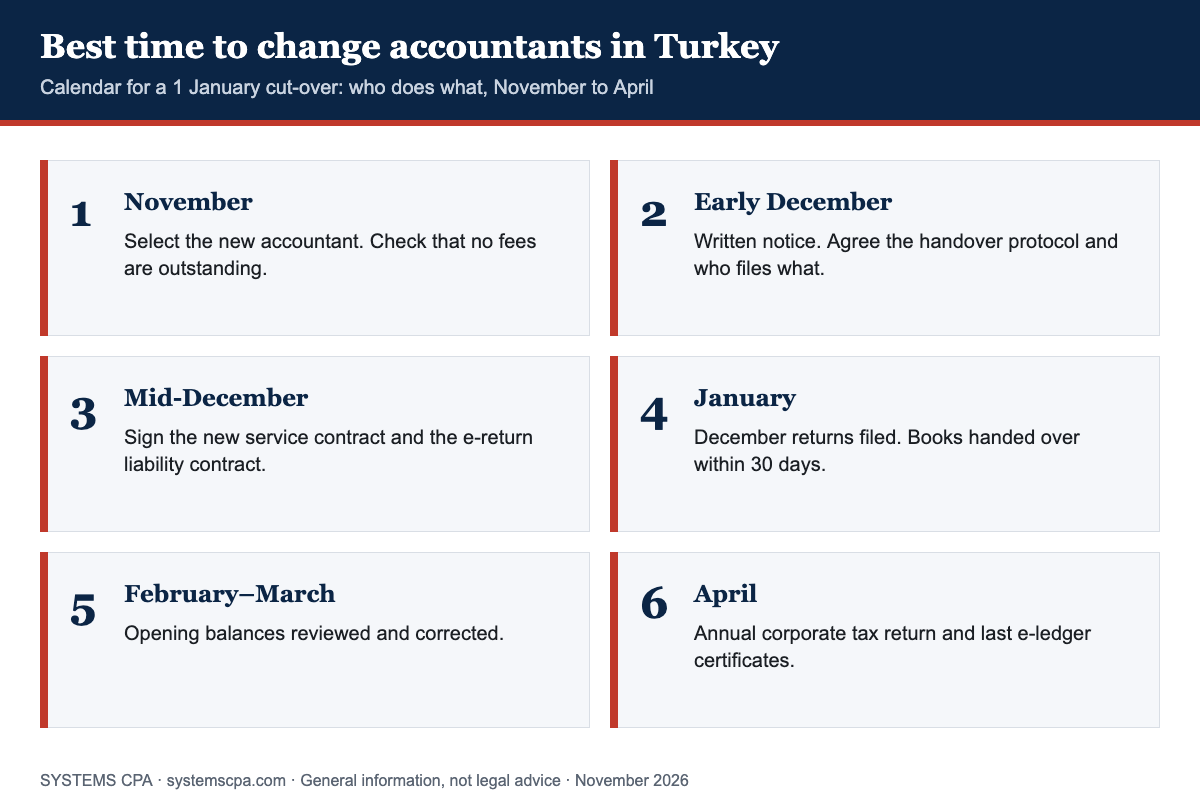
Best time to change accountants: a November-to-April calendar
- November: shortlist and select the new accountant; check that no fees are outstanding to the current one.
- Early December: give written notice under the existing contract; agree the handover protocol and who files what.
- Mid-December: sign the new service contract; the new accountant registers it and enters the e-return intermediary and liability contract effective for the new period.
- 31 December: year-end count and cut-off; bank, supplier and customer reconciliations frozen.
- January: December returns filed by the agreed party; books and documents handed over with a handover record within 30 days; system access and passwords changed.
- February–March: opening balances reviewed; differences documented and corrected.
- April: annual corporate tax return filed and last e-ledger certificates uploaded by the agreed party.
What happens if…?
What happens if we decide to switch in the last week of December?
The switch can still take effect on 1 January, but expect the outgoing accountant to file the December returns in January and to hand over later. Sign the new contracts immediately, fix the allocation in writing and schedule the opening-balance review for February rather than rushing it.
What happens if the outgoing accountant refuses to close the year?
The incoming accountant closes it, on books kept by someone else. That is workable but needs a documented review of the year before the annual return is signed, and the engagement letter should say so. Any fee dispute should be settled or formally contested first, because unpaid fees prevent another CPA from accepting the work.
What happens if we switch in the middle of a quarter?
The provisional corporate tax return for that quarter will rest on books kept by two firms. It can be done, but the incoming accountant should receive a reconciled trial balance at the cut-off date and should be the one to file the quarter’s return.
Case analyses
Anonymized composites built from recurring patterns; illustrative only. Both show that the best time to change accountants depends on how urgent the problem is.
Case 1 — Decided in November, quiet in January
- Facts
- A French group’s Turkish sales company received its monthly reporting pack three weeks late all year. The group decided in mid-November to change accountants.
- The obvious answer
- Terminate immediately and move everything in November.
- Why it would have failed
- Two firms would have shared the fourth quarter, the year-end close and the annual return, with no clear owner for any of them.
- The structure adopted
- Notice in early December, cut-over on 1 January, the outgoing accountant filing December returns and closing the year, the incoming accountant reviewing the close before the April return.
- Lesson
- Decide early, cut over at year-end, and write down who owns the old year.
Case 2 — A problem that could not wait
- Facts
- In August a US-owned subsidiary learned that two VAT returns had been filed late and penalties assessed.
- The obvious answer
- Wait for January to keep the year in one hand.
- Why it would have failed
- Four more months of the same risk, including the third-quarter provisional tax return.
- The structure adopted
- Cut-over at 30 September with a reconciled trial balance; the incoming accountant filed the third-quarter return and took the year-end.
- Lesson
- A quarter-end is the next-best date when January is too far away.
What drives the cost of changing accountants in Turkey?
The cost of changing accountants in Turkey is driven by the state of the existing books, the number of months to be reviewed or re-performed, payroll headcount, the number of systems to migrate, and whether the outgoing accountant cooperates. The best time to change accountants is also the cheapest one: a year-end switch with clean books costs least, while a mid-year switch with unreconciled balances costs most.
| Driver | Lower effort | Higher effort |
|---|---|---|
| Timing | 1 January | Mid-quarter |
| Books | Reconciled monthly | Open items from prior years |
| Payroll | Few employees, clean records | Many employees, missing leave and severance data |
| Systems | Same e-ledger and e-invoice provider kept | Provider change and data migration |
| Cooperation | Agreed handover protocol | Dispute with the outgoing accountant |
Changing accountants: Turkey vs the United Kingdom
The best time to change accountants is a practical question in both countries, because in both Turkey and the United Kingdom a company may change accountants at any time. The difference is formal. In the United Kingdom the new accountant sends a professional clearance letter to the old one. In Turkey the professional rules go further: a CPA may not accept a client with unpaid fees to the previous CPA, and filing authority depends on a contract recorded in the tax office system.
| Point | Turkey | United Kingdom |
|---|---|---|
| Contact between old and new accountant | New CPA may ask the previous CPA about the client before accepting | Professional clearance letter |
| Unpaid fees | Bar to accepting the engagement | Practical obstacle, not a statutory bar |
| Filing authority | E-return intermediary and liability contract in the tax office system | Agent authorisation with the tax authority |
| Return of records | Within 30 days with a handover record | Governed by professional body guidance and contract |
The UK column is a general orientation, not advice on UK rules.
Conclusion
The best time to change accountants in Turkey is 1 January, decided by early December. If the problem is urgent, switch at the next month-end or quarter-end instead of waiting. In both cases the outcome depends less on the date than on a written allocation of the filings that fall due during the transition.
Accounting takeover planned around your year-end
Peace of Mind for the months when two accountants overlap.
- Cut-over date and filing allocation agreed in writing
- New contracts and tax office authorisations in place before the first filing
- Handover checklist and 30-day follow-up with the outgoing accountant
- Opening-balance review before the annual return
- Always-on Compliance from the first month
We keep books and file returns as licensed CPAs; legal disputes are handled with your Turkish counsel. Engagements start with a paid scoping consultation, and fees are confirmed in writing.
Request the review by emailRequest a proposal
info@ozmconsultancy.com · +90 216 352 29 61 · WhatsApp +90 506 682 96 55 · Deluxia Palace, Batı Ataşehir, Istanbul
Frequently asked questions on the best time to change accountants
Do I have to wait until year-end to change accountants in Turkey?
No. A company may change its accountant at any time. Year-end is the cleanest date because books, payroll and the tax year restart on 1 January, but a mid-year switch at a month-end or quarter-end is common and lawful.
How much notice do I have to give my Turkish accountant?
The notice period is the one written in your service contract. Check the termination clause and any fees due for the notice period before you set the cut-over date, and give notice in writing.
Can the new accountant start before the old one has handed over the books?
Yes, once the new contracts are in place. The new accountant can start the new period from bank, e-invoice and e-ledger data while the handover is completed. The outgoing accountant must return books and documents within 30 days of termination.
Who files the December VAT return in a January switch?
Whoever the two contracts say. In practice the outgoing accountant usually files December returns in January because the period belongs to the old year and the data is in their system. Put it in writing.
Is January too late to switch for the current year?
No. A switch agreed in January can take effect from 1 January or from 1 February. The later the decision, the more of the old year’s close will be done by the outgoing accountant, so the opening-balance review becomes more important.
Does changing accountants trigger a tax audit in Turkey?
There is no rule under which a change of accountant by itself triggers a tax examination. Corrections filed after the new accountant reviews earlier periods can attract attention, which is one reason to review opening balances carefully and correct voluntarily where needed.
Primary sources
- Law No. 3568 on Certified Public Accountancy and Sworn-in Certified Public Accountancy: mevzuat.gov.tr
- Regulation on the Working Procedures and Principles of CPAs and Sworn-in CPAs, Arts. 23, 26 and 27: turmob.org.tr
- Disciplinary Regulation under Law No. 3568 (handover of books within 30 days): TÜRMOB consolidated text
- Regulation on Unfair Competition and the Advertising Ban, Art. 7: Official Gazette of 21 November 2007, No. 26707
- Tax Procedure Law No. 213, Arts. 185–186, 221 and repeated Art. 227; General Communiqué No. 340 (e-return intermediary and liability contract): mevzuat.gov.tr; gib.gov.tr
- Corporate Tax Law No. 5520, Art. 14 (filing period): mevzuat.gov.tr
- Turkish Commercial Code No. 6102, Arts. 64 and 82: mevzuat.gov.tr
- Revenue Administration e-ledger rules: edefter.gov.tr
This article is provided for general informational purposes and does not constitute legal, tax, accounting or investment advice. Professional rules, deadlines and figures are stated as of 11 November 2026 and depend on the specific facts. Professional advice should be obtained before taking action.
Turn Turkey compliance into certainty
SYSTEMS CPA supports foreign-owned companies with company formation, accounting, tax compliance and payroll in Turkey — one accountable local partner. Reviewed by Evren Özmen, SMMM (Certified Public Accountant), TÜRMOB Reg. No. 35675.
