
Peace of Mind · Accounting takeover process · Day 1 to Day 30 · Tax Procedure Law · Law No. 3568
Accounting Takeover Process in Turkey: What Happens in the First 30 Days
The accounting takeover process in Turkey takes about 30 days for a company with clean, electronic records. The first week moves filing authority and system access to the new Certified Public Accountant (CPA); the rest of the month covers the handover record, the opening-balance check and the first VAT and payroll returns. This guide shows what happens on which day, who owns each step, and which records must still be producible years later.
Accounting takeover in Turkey › The first 30 days
Start with access, not paperwork. Until the new CPA holds the e-filing contract and the company controls its own portal credentials, nobody can file safely. Books and historic records can follow within the 30-day handover period.
- Days 1–7: the e-filing intermediary contract, the company’s tax office and social security (SGK) credentials, the financial seal, the e-invoice provider account and the e-notification inbox move first.
- Within 30 days: the outgoing CPA must hand over books and documents with a handover record issued through TÜRMOB’s e-Birlik system.
- Fees first: a new CPA may not serve a company that still owes fees to another CPA (Unfair Competition Regulation Art. 7(1)(c)).
- First deadlines: payroll and withholding return by the 26th, VAT return by the 28th, Ba-Bs forms by the end of the month.
- The long tail: the company, not the accountant, must keep and produce its books: five years under the Tax Procedure Law and ten years under the Turkish Commercial Code.
Key facts at a glance
| Question | Answer | Basis |
|---|---|---|
| How long does it take? | About 30 days for a company with clean, electronic records; 60–90 days where there is a backlog or open reconciliation items. | 30-day handover period; professional practice |
| What moves first? | Filing authority: the electronic return intermediary and liability contract, entered in the Revenue Administration (GİB) system. | Tax Procedure Law General Communiqués No. 340 and 405 |
| When must the old CPA record the termination? | Within 15 days of termination, in the internet tax office. | General Communiqué No. 405 |
| When must the books be returned? | Within 30 days of termination, with a handover record issued through e-Birlik. | Disciplinary Regulation Art. 5(1)(a); Unfair Competition Regulation Art. 6(1)(i) |
| Can the new CPA start if fees are unpaid? | No. Serving a client that owes fees to another CPA is unfair competition. | Unfair Competition Regulation Art. 7(1)(c) |
| Who must keep the records? | The company: five years for tax purposes, ten years under commercial law. | Tax Procedure Law Art. 253; Turkish Commercial Code Art. 82 |
| What if books cannot be produced in an audit? | Estimated assessment, disallowed VAT deductions, penalties and, where the legal conditions are met, criminal exposure. | Tax Procedure Law Arts. 30, 256, 359; VAT Law Arts. 29, 34 |
| First filings after the switch | Payroll and withholding return (26th), VAT return (28th), Ba-Bs forms (month-end), e-ledger certificates (berat) on a rolling four-month cycle. | Revenue Administration calendar; e-Ledger General Communiqué No. 1 |
How long does the accounting takeover process take in Turkey?
A clean accounting takeover process in Turkey takes about 30 days: one week to move filing authority and system access, then three weeks to receive the books with a handover record, verify the opening balances and file the first returns. Companies with a backlog, missing records or a fee dispute should plan for 60 to 90 days.
The 30-day figure is not arbitrary. Turkish professional rules give the outgoing CPA 30 days from termination to hand over books and documents, and the monthly tax calendar sets the first hard deadlines on the 26th and 28th of the month after the cut-over period. A takeover planned around those two clocks rarely misses a filing.
What lengthens the process is almost never the paperwork itself. It is unpaid fees, access held in the outgoing accountant’s name, e-ledger months that were never closed, or balances nobody can explain. The plan below is built to surface those issues in the first week, not in the first tax examination.
When a finance director asks me how long a takeover will take, I ask two questions back: who holds the passwords today, and when was the last e-ledger certificate uploaded? Those answers predict the timeline better than transaction volume. A company that controls its own access is usually running cleanly within a month.
The accounting takeover process, day by day
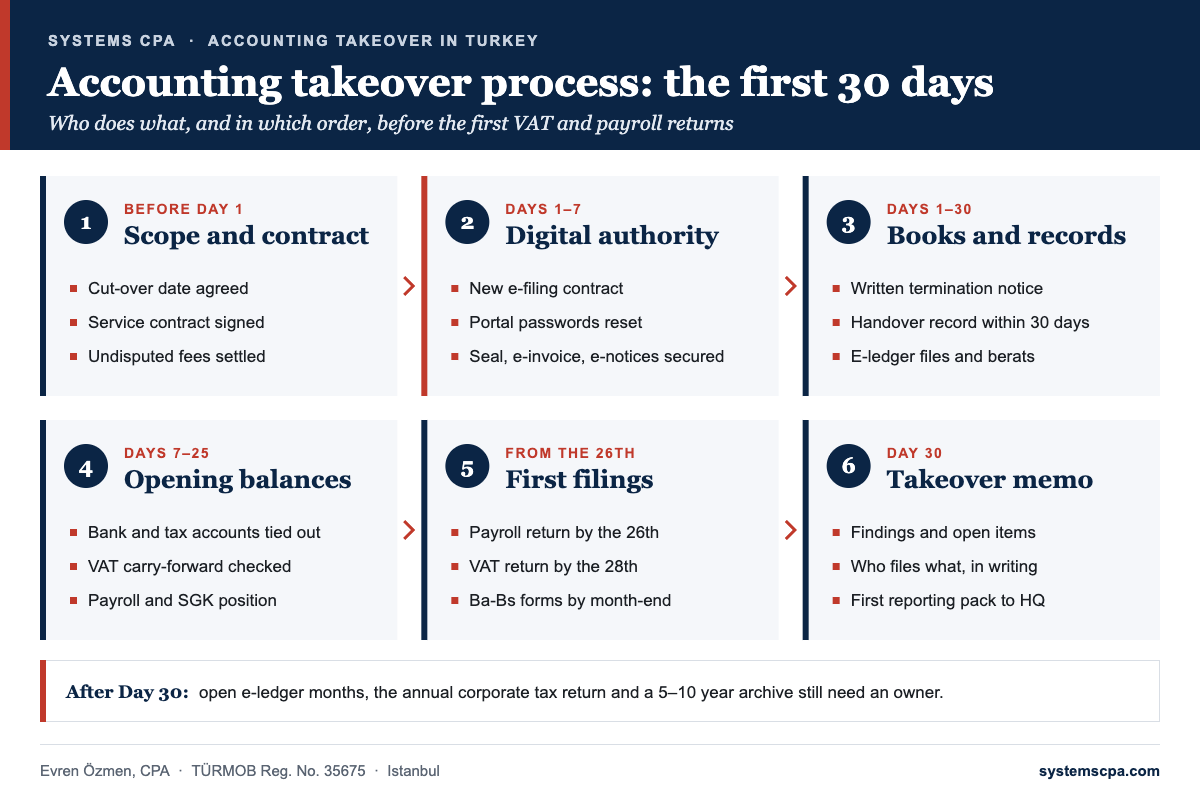
The accounting takeover process in Turkey runs in six stages: scope and contract before Day 1, digital authority in Days 1–7, books and records within 30 days, opening balances in Days 7–25, the first returns from the 26th of the month, and a written takeover memo at Day 30. Each stage needs a named owner.
| Stage | When | What happens | Owner |
|---|---|---|---|
| 1. Scope and contract | Before Day 1 | Cut-over date; written split of open returns; service contract registered in TÜRMOB’s e-Birlik system; fee position with the outgoing CPA confirmed | Company and new CPA |
| 2. Digital authority | Days 1–7 | New e-filing intermediary contract entered with the Revenue Administration; termination recorded by the outgoing CPA; company credentials renewed; financial seal, e-invoice provider and e-notification inbox secured | New CPA, company, outgoing CPA |
| 3. Books and records | Days 1–30 | Written termination; handover record through e-Birlik within 30 days; prior e-ledger files and certificates, returns, payroll files, fixed asset register and correspondence | Outgoing CPA |
| 4. Opening balances | Days 7–25 | Trial balance tied to bank statements, the tax office account, VAT carried forward, SGK debt status, payroll accruals and intercompany balances | New CPA |
| 5. First filings | 26th to month-end | Payroll and withholding return (26th), VAT return (28th) and Ba-Bs forms (month-end) for the agreed periods | As agreed in writing |
| 6. Takeover memo | Day 30 | Findings, open items, inherited risks, archive location and who files what for the rest of the year | New CPA |
Before Day 1: scope, contract and fees
Agree the cut-over date first, normally a month-end, and decide in writing who files each open return for the outgoing CPA’s last period. The new CPA then signs a written service contract with the company. Turkish CPAs record that contract in TÜRMOB’s e-Birlik system, and the Revenue Administration checks the e-filing contract against it before accepting it.
Check the fee position at the same time. Under Article 7(1)(c) of the Unfair Competition and Advertising Ban Regulation, serving a client that has not paid fees owed to another CPA is unfair competition. In practice, a new CPA will not file anything until that point is settled or formally documented.
Days 1–7: move filing authority and system access
Filing authority is the critical path of the accounting takeover process. A Turkish CPA files a company’s returns under the electronic return intermediary and liability contract (Elektronik Beyanname Aracılık ve Sorumluluk Sözleşmesi) introduced by Tax Procedure Law General Communiqué No. 340. The contract must be entered in the internet tax office before the CPA can file, and the outgoing CPA must record the termination of its own contract within 15 days (General Communiqué No. 405).
- New e-filing contract: entered by the new CPA and, where the company holds its own e-filing credentials, approved by the company in the Interactive Tax Office.
- Company credentials: the authorized signatory renews the company’s own tax office user code and password and its SGK employer credentials, so access no longer depends on any accountant.
- Financial seal (mali mühür): the certificate issued by Kamu SM that signs e-invoices and e-ledger files. Recover the device and its PIN, or apply for a new certificate at once if it cannot be found.
- E-invoice and e-ledger provider: confirm that the provider contract is in the company’s name and that the new CPA has its own user. If the account sits under the old accountant, migrate it now.
- E-notification inbox: corporate taxpayers must use the electronic notification system (Tax Procedure Law Art. 107/A, as amended by Law No. 7587 from 1 July 2026). A notice counts as served at the end of the fifth day after delivery, so name the person who reads the inbox from Day 1.
Days 1–30: books, documents and the handover record
The outgoing CPA must return the company’s books and documents with a handover record (devir teslim tutanağı) within 30 days of termination. Failing to do so is a disciplinary offence under Article 5(1)(a) of the Disciplinary Regulation, and since 24 February 2025 not issuing the handover record through the e-Birlik software within 30 days is also listed as unfair competition (Unfair Competition Regulation Art. 6(1)(i)).
Ask for the electronic records as well as the paper: e-ledger files and certificates (berat) for every year, filed returns and accruals, payroll registers, the fixed asset register, contracts, tax office correspondence and any open VAT refund file. If the outgoing firm refuses, our guide on what to do when a Turkish accountant refuses to hand over books sets out the remedies.
Days 7–25: verify the opening balances
The outgoing CPA’s closing trial balance becomes the new CPA’s starting point, so it must be tested before anyone relies on it. In a takeover month we tie six figures to independent evidence: bank balances, the tax office account statement, the VAT carried forward on the last return, the SGK debt position, payroll accruals and intercompany balances with the parent.
The full document list and the balance-sheet areas to review are in our accounting handover checklist for Turkey. The point here is timing: the tie-out must finish before the 26th, because the first payroll and VAT returns are built on these numbers.
From the 26th: the first filings
The first hard deadlines fall in the month after the cut-over period: the payroll and withholding return (Muhtasar ve Prim Hizmet Beyannamesi) by the 26th, the VAT return by the 28th and the Ba-Bs purchase and sales forms by the last day of the month. Deadlines that fall on a weekend or public holiday move to the next working day.
A late payroll return costs more than a penalty. The Treasury-funded employer premium discount under Social Security Law No. 5510, Art. 81 depends on timely filing and payment, so a missed return in the takeover month can cost the discount for that month. The written split of returns must therefore name an owner for each one.
Day 30: the takeover memo
The accounting takeover process ends with a written takeover memo: what was received and what is missing, which balances were verified, which inherited issues need correction, where the archive is kept and who files each remaining return for the year. It turns the takeover from a series of calls into a record the company can show an auditor or a tax inspector.
Planning a switch at year-end? Email us your cut-over date and the last month your current accountant filed, and we will map your Day 1–30 plan. Send the two dates →
Worked calendar: an accounting takeover on 1 January 2027
For a company that switches CPAs on 1 January 2027 after a 31 December 2026 cut-over, the December payroll return is due on 26 January, the December VAT return on 28 January and the Ba-Bs forms on 1 February 2027. E-ledger certificates for September to December 2026 fall due between 14 January and 14 May 2027, and the 2026 corporate tax return by 30 April 2027.
| Date | Obligation | Period | Typical owner |
|---|---|---|---|
| 31 Dec 2026 | Outgoing engagement ends; written notice served earlier in December | — | Company |
| 1 Jan 2027 | New engagement starts; new e-filing contract entered | From January 2027 | New CPA |
| 14 Jan 2027 | E-ledger certificate (berat), monthly upload | September 2026 | Outgoing CPA |
| 15 Jan 2027 | Termination of the old e-filing contract recorded (15 days) | — | Outgoing CPA |
| 26 Jan 2027 | Payroll and withholding return (monthly filers) | December 2026 | As agreed in writing |
| 28 Jan 2027 | VAT return | December 2026 | As agreed in writing |
| By 30 Jan 2027 | Books and documents handed over with an e-Birlik handover record (30 days) | All prior periods | Outgoing CPA |
| 1 Feb 2027 | Ba-Bs forms (31 January is a Sunday) | December 2026 | As agreed in writing |
| 15 Feb 2027 | E-ledger certificate (14 February is a Sunday) | October 2026 | As agreed in writing |
| 15 Mar 2027 | E-ledger certificate (14 March is a Sunday) | November 2026 | As agreed in writing |
| 30 Apr 2027 | Annual corporate tax return and payment | 2026 | As agreed in writing |
| 14 May 2027 | Closing e-ledger certificate | December 2026 | As agreed in writing |
Assumes a calendar-year company that files payroll returns monthly and uploads e-ledger certificates monthly (e-Ledger General Communiqué No. 1, para. 4.3.4, as amended by Communiqué No. 5), with no extension announced by the Revenue Administration. Who files the 2026 annual return is a separate decision, covered in who files the tax return after switching accountants in Turkey.
Who does what: company, outgoing CPA and new CPA
In the accounting takeover process the company owns the decision and its credentials, the outgoing CPA owns the handover of books, documents and its own open periods, and the new CPA owns the new filing authority, the opening-balance check and every return from the cut-over date. Writing this split down prevents missed and duplicated filings.
| Task | Company | Outgoing CPA | New CPA |
|---|---|---|---|
| Termination and cut-over date | Decides and signs | Acknowledges | Advises on timing |
| Fees owed to the outgoing CPA | Pays or formally disputes | Confirms the position | Cannot take the client until settled or documented |
| E-filing intermediary contract | Approves where required | Records termination within 15 days | Enters the new contract |
| Tax office and SGK credentials | Renews in its own name | Stops using them | Receives its own access |
| Financial seal and e-document provider | Holds the seal and the contract | Returns any device or account | Gets its own user |
| Books, documents and e-ledger archive | Receives and stores | Hands over within 30 days with the handover record | Checks completeness |
| Open returns for the last period | Approves the written split | Files what the split gives it | Files what the split gives it |
| Opening balances | Provides bank and group data | Answers questions | Verifies and documents |
The handover goes faster when the two accountants speak directly. I usually call the outgoing colleague in the first week, agree the list and the date, and confirm it in writing the same day. Once the fee question is settled and the request is precise, most outgoing accountants cooperate.
Digital access vs paper records: what must transfer first?
Digital access must transfer first because it decides whether anyone can file: the e-filing contract, portal credentials, the financial seal and the e-document provider account. Paper books and current files can follow within the 30-day handover period. The historic archive is a third layer that must stay producible for five to ten years after the takeover.
| Layer | Examples | Time pressure | Risk if it slips |
|---|---|---|---|
| Digital authority | E-filing contract, tax office and SGK credentials, financial seal, e-invoice provider, e-notification inbox | Days; before the 26th | Returns cannot be filed; notices are served without anyone reading them |
| Current records | Trial balance, open returns, payroll files, contracts, bank reconciliations | Within 30 days of termination | Opening balances cannot be verified |
| Historic archive | E-ledger files and certificates for prior years, prior returns, supporting documents | Five to ten years | Records cannot be produced in a tax examination |
Can you still produce your e-ledger five years after the takeover?
Only if the takeover moves the archive deliberately. Tax Procedure Law Art. 253 requires the company to keep its books for five years from the calendar year after the year they relate to, and Turkish Commercial Code Art. 82 sets ten years. The duty stays with the company when accounting is outsourced and when the provider changes.
Picture a tax examination that asks your Turkish subsidiary for its 2021 e-ledger files and their certificates. The accountant who kept them left three years ago. The question that matters is no longer the annual fee. It is who holds the original files, in which format, and who can retrieve them within the period the inspector sets.
Since January 2020, secondary copies of e-ledger and certificate files must also be uploaded to the Revenue Administration’s systems, or to an authorized storage provider, and kept for at least ten years (e-Ledger General Communiqué No. 1, as amended by Communiqué No. 3, Official Gazette 19 October 2019, No. 30923). Those copies are stored encrypted as a backup for the administration. They do not discharge the company’s own duty to keep and produce the books, and periods before 2020 are not covered.
When books cannot be produced, the consequences are not automatic, but they are real. The tax office may assess on an estimated basis (Tax Procedure Law Art. 30), VAT deductions that depend on invoices recorded in the books can be disallowed (VAT Law Arts. 29 and 34), and where the books are shown to exist but are not produced to an authorized inspector, Art. 359(a)(2) treats the failure as concealment, punishable by 18 months to three years’ imprisonment.
| Area | Question to ask |
|---|---|
| Preparation | Are the statutory ledgers prepared in the required e-ledger format for every month? |
| Filing | Were all e-ledger certificates (berat) uploaded on time, and is there a list of the acceptance confirmations? |
| Preservation | Where are the original e-ledger files and certificates kept, and in whose account? |
| Secondary copies | Were secondary copies uploaded for every month since January 2020? |
| Accessibility | Could the company retrieve its complete records for a year five years ago without the provider? |
| Continuity | What happens to the archive if the provider changes again? |
| Tax audit support | Who retrieves and produces the records when an inspector asks? |
| Accountability | Which of these duties are written into the service contract? |
In a takeover I treat the e-ledger archive as a deliverable of its own. We list every month since the company joined the e-ledger system, check that a certificate exists for each one, and make sure a complete copy sits in storage the company controls. It takes hours, and it answers the audit question years before anyone asks it.
What happens if…?
What happens if the previous accountant still has filing authority after you terminate?
Until the termination is recorded in the tax office system, the outgoing CPA’s authority remains on record. Ask for the termination to be recorded at once, since the rules allow 15 days, and check the list of filed returns in the tax office portal after every deadline in the transition months.
What happens if a tax notice arrives during the takeover?
It is served whether or not anyone reads it. An electronic notice counts as delivered at the end of the fifth day after it reaches the company’s e-notification inbox (Tax Procedure Law Art. 107/A). Objection and payment periods run from that date, so the inbox owner must be named on Day 1.
What happens if e-ledger certificates for earlier months were never uploaded?
Those months must be closed before the new CPA builds on them. Late certificates create penalty exposure for each period and weaken the evidential value of the books. Identify the gap in the first week, agree who uploads the missing months and record the position in the takeover memo.
What happens if the outgoing accountant will not hand over the books?
Separate the fee question from the records question and act on both: pay what is undisputed, contest the rest in writing, demand the books with a deadline and recover system access yourself. If 30 days pass, complain to the chamber of CPAs where the accountant is registered. The full sequence is in our guide on what to do when a Turkish accountant refuses to hand over books.
What happens if the takeover starts in the middle of a VAT refund claim?
The refund file belongs to the company and moves with it. The new CPA needs the refund petitions, the supporting lists, any sworn CPA (YMM) report and the tax office correspondence, and should not restart the claim from zero. Agree in writing who answers the tax office’s questions on the open file.
What happens if you change accountants during a tax examination?
You can, but plan it. The examination is addressed to the company, which remains obliged to produce its books. Tell the inspector in writing who the new CPA is and where the records are, and make sure the handover does not interrupt any period set in the examination.
Case analysis
Anonymized composites built from recurring patterns; illustrative only.
Case 1 — The takeover that started with the paperwork
- Facts
- A German-owned trading company in Istanbul changed CPAs at the end of February. The finance director asked the new firm to begin by collecting the paper files from the previous accountant.
- The obvious answer
- Collect the books first and deal with the systems later.
- Why it would have failed
- The outgoing CPA still held filing authority, the e-invoice provider account sat under the accountant’s own login, and nobody was reading the company’s e-notification inbox. A corrected January VAT return could have been filed without the new firm’s knowledge, and a tax office request could have gone unanswered past its deadline.
- The structure adopted
- Access moved in a single day: the new e-filing contract was entered, the company renewed its own credentials, the e-invoice account was moved into the company’s name and the finance director became the named inbox owner. The books followed within the 30-day period under a written split of returns.
- Lesson
- In the accounting takeover process, access is Day 1 work and paper is Day 30 work.
Case 2 — The 2021 e-ledger request
- Facts
- A US-owned services subsidiary had changed accounting providers twice. During a tax examination, the inspector asked for the 2021 e-ledger files and their certificates.
- The obvious answer
- Ask the firm that kept the books in 2021.
- Why it would have failed
- That firm no longer used the same e-ledger software, and the company had never kept its own copies. Secondary copies existed in the Revenue Administration’s systems, but under the e-ledger rules they do not discharge the company’s own duty to keep and produce the books.
- The structure adopted
- The files were recovered from the e-ledger provider’s archive with the company’s financial seal and produced to the inspector. The new engagement added archive custody to its scope: a yearly check that every month since 2020 has a certificate and a complete copy in storage the company controls.
- Lesson
- Archive custody belongs inside the accounting takeover process, not after it.
Case 3 — The January switch with four open months
- Facts
- A Dutch-owned manufacturer moved to a new CPA on 1 January. Nobody had decided who would sign the e-ledger certificates for September to December or who would prepare the annual corporate tax return.
- The obvious answer
- The old accountant finishes its own year.
- Why it would have failed
- The outgoing engagement ended on 31 December and its fee did not cover year-end work, while the September certificate was due within two weeks and the closing certificate for December only in May.
- The structure adopted
- A written split: the outgoing CPA closed and signed September and October for an agreed additional fee; the new CPA took November, December and the annual return after reviewing the year-end adjustments, and the handover record listed which months each firm had signed.
- Lesson
- At a 1 January switch the previous year is not finished. Give every open month an owner before Day 1.
Five mistakes that slow down an accounting takeover
- Starting with paper instead of access. Files can wait a few weeks; filing authority and credentials cannot.
- Leaving the fee question open. A new CPA may not take on a client that owes fees to another CPA, so one unresolved invoice can stop the whole process.
- No written split of open returns. “The old accountant will finish the year” is not a plan. Each return and each open e-ledger month needs a named owner.
- Importing the opening trial balance untested. An unexplained balance does not become correct because it moves to a new firm.
- Forgetting the archive. The company must still produce prior years’ books after the provider changes, so collect the e-ledger files and certificates now.
What drives the cost of an accounting takeover in Turkey?
The cost of an accounting takeover in Turkey depends on how much has to be verified or rebuilt, not on the handover itself. The main drivers are the state of the records, who controls system access, the number of open periods, payroll size, open VAT refund or incentive files, group reporting needs and whether the outgoing CPA cooperates.
| Driver | Lower effort | Higher effort |
|---|---|---|
| Records | E-ledger and e-invoice company, reconciled monthly | Backlog, paper-heavy or unreconciled accounts |
| Access | Company holds its credentials and seal | Everything held by the outgoing accountant |
| Open periods | Clean month-end cut-over | Several unclosed months or an open annual return |
| Payroll | Few employees, no incentives | Larger payroll, incentive claims, foreign staff |
| Special files | None | VAT refund, incentive certificate or open tax examination |
| Group reporting | Statutory accounts only | IFRS or US GAAP pack on a group deadline |
| Cooperation | Fees settled, professional handover | Fee dispute or chamber complaint |
We confirm the one-off takeover work and the monthly Always-on Compliance scope separately and in writing, after a paid scoping consultation.
Accounting takeover in Turkey vs the UK and Germany
Turkey regulates the changeover more tightly than the UK or Germany: a 30-day handover period with a disciplinary sanction, a handover record issued through TÜRMOB’s e-Birlik system, and a rule that a new CPA may not serve a client with unpaid fees. In the UK, a professional enquiry and a new HMRC agent authorization drive the switch; in Germany, the adviser may withhold the file until fees are paid.
| Point | Turkey | United Kingdom | Germany |
|---|---|---|---|
| Contact with the outgoing adviser | Handover record issued through TÜRMOB’s e-Birlik system; direct CPA-to-CPA contact in practice | Professional enquiry (clearance) letter under the accountancy bodies’ ethics codes | Request for the client file (Handakten) |
| Filing authority | New e-filing contract entered with the Revenue Administration; outgoing CPA records termination within 15 days | A new HMRC agent authorization replaces the existing one | New power of attorney for the new adviser |
| Unpaid fees | New CPA may not serve the client (Unfair Competition Regulation Art. 7(1)(c)) | A lien over some documents is possible; raised in the clearance exchange | Adviser may refuse to release the file until paid (Tax Advisers Act, StBerG § 66), within good-faith limits |
| Deadline to return records | 30 days from termination | No single statutory period | No fixed period; on request |
The UK and German columns are a general orientation for finance teams used to those systems, not advice on UK or German rules.
Conclusion
The accounting takeover process in Turkey is short when it runs in the right order: access in the first week, books and documents within the 30-day handover period, verified opening balances before the 26th, and a written takeover memo at Day 30. The company stays responsible for its records throughout, so the e-ledger archive deserves the same attention as the first VAT return.
Plan your accounting takeover process with SYSTEMS CPA
Peace of Mind from the first day of the switch.
- Day 1–7 access plan: e-filing contract, credentials, financial seal, e-invoice provider and e-notification inbox
- A written split of every open return and e-ledger month
- Handover record, opening-balance tie-out and takeover memo by Day 30
- E-ledger archive check for every month since the company joined the system
- First returns and the group reporting pack on time, then Always-on Compliance
Send three facts and we will reply with a takeover timeline and a written proposal: the last month your current accountant filed, the number of employees on payroll and your preferred cut-over date. We file returns and keep books as licensed CPAs; disputes are handled with your Turkish counsel. Engagements start with a paid scoping consultation, and fees are confirmed in writing.
Email the three factsWhatsApp usRequest a proposal
info@ozmconsultancy.com · +90 216 352 29 61 · WhatsApp +90 506 682 96 55 · Deluxia Palace, Batı Ataşehir, Istanbul
Frequently asked questions
How long does it take to change accountants in Turkey?
About 30 days for a company with clean electronic records: one week to move filing authority and system access, and the rest of the month for the handover record, the opening-balance check and the first returns. A backlog, missing records or a fee dispute can extend the accounting takeover process to 60–90 days.
What is the first step when a new accountant takes over a Turkish company?
Moving filing authority. The new CPA enters the electronic return intermediary and liability contract with the Revenue Administration, the company renews its own tax office and SGK credentials, and the financial seal and e-invoice provider account are secured. Paper files can follow within the 30-day handover period.
Do I need my current accountant’s permission to switch?
No. The company can end the engagement under the contract and the professional rules, and the outgoing CPA must hand over the books within 30 days. Unpaid fees matter, though: a new CPA may not serve a company that still owes fees to another CPA, so settle or formally dispute them first.
Who files the returns for the month we switch?
Whoever the written split of returns names. Usually the outgoing CPA files for the periods in which it kept the books and the new CPA files from the cut-over date, but open e-ledger months and the annual corporate tax return need their own decision, agreed before Day 1.
What happens to our e-ledger files when we change accountants?
They remain the company’s records, and the company must keep and produce them for five years under the Tax Procedure Law and ten years under the Turkish Commercial Code. Ask for the files and certificates for every year, and check that secondary copies were uploaded for each month since January 2020.
Can we change accountants in the middle of the year in Turkey?
Yes. A month-end cut-over is easiest, but there is no legal requirement to wait for 31 December. A mid-year switch needs the same Day 1–30 sequence plus a clear split of the provisional tax and annual return work for that year.
Does the new accountant contact the old one?
In practice, yes. Direct CPA-to-CPA contact settles the handover list, the fee position and the date faster than messages relayed through the company. The handover record itself is issued through TÜRMOB’s e-Birlik system.
Can the accounting takeover be handled in English?
Yes. The takeover plan, the written split of returns, the takeover memo and the monthly reporting to the parent company can all be prepared in English. Returns and correspondence with the Turkish tax office and SGK are filed in Turkish.
Primary sources
- Tax Procedure Law No. 213, Arts. 30, 107/A, 253, 256 and 359: mevzuat.gov.tr
- Law No. 7587 amending Tax Procedure Law Art. 107/A (Official Gazette 1 July 2026, No. 33297): Official Gazette; Tax Procedure Law General Communiqué No. 596 on electronic notification (Official Gazette 11 October 2026, No. 33397): Official Gazette
- Tax Procedure Law General Communiqués No. 340 and No. 405 (electronic return intermediary and liability contract): gib.gov.tr
- e-Ledger General Communiqué No. 1 (Official Gazette 13 December 2011, No. 28141), as amended by Communiqué No. 3 (19 October 2019, No. 30923) and No. 5 (8 November 2024, No. 32716): edefter.gov.tr; Official Gazette No. 30923; Official Gazette No. 32716
- Law No. 3568 on Certified Public Accountancy and Sworn-in Certified Public Accountancy: mevzuat.gov.tr
- Regulation on the Working Procedures and Principles of CPAs and Sworn-in CPAs (Official Gazette 3 January 1990, No. 20391), Art. 26: TÜRMOB consolidated text
- Disciplinary Regulation under Law No. 3568, Art. 5(1)(a): TÜRMOB consolidated text
- Unfair Competition and Advertising Ban Regulation, Arts. 6(1)(i) and 7(1)(c) (Official Gazette 21 November 2007, No. 26707; amended 24 February 2025, No. 32823): Official Gazette No. 26707; Official Gazette No. 32823
- Turkish Commercial Code No. 6102, Art. 82: mevzuat.gov.tr
- VAT Law No. 3065, Arts. 29 and 34: mevzuat.gov.tr
- Corporate Tax Law No. 5520, Arts. 14 and 21 (annual return and payment): mevzuat.gov.tr
- Social Security and General Health Insurance Law No. 5510, Art. 81: mevzuat.gov.tr
- ICAEW, Change of professional appointment – outgoing accountant (helpsheet): icaew.com
- German Tax Advisers Act (Steuerberatungsgesetz), § 66: gesetze-im-internet.de
This article is provided for general informational purposes and does not constitute legal, tax, accounting or investment advice. Professional rules, deadlines and figures are stated as of 14 November 2026 and depend on the specific facts. Professional advice should be obtained before taking action.
Turn Turkey compliance into certainty
SYSTEMS CPA supports foreign-owned companies with company formation, accounting, tax compliance and payroll in Turkey — one accountable local partner. Reviewed by Evren Özmen, SMMM (Certified Public Accountant), TÜRMOB Reg. No. 35675.
