
Accounting Handover Checklist in Turkey: What to Collect Before You Switch Accountants
Changing your accounting provider in Turkey should not be treated as a simple transfer of files. For a foreign subsidiary, the real task is to protect tax continuity, validate opening balances, preserve payroll and e-ledger records, and ensure that headquarters receives reliable financial data from day one. This accounting handover checklist covers what to collect, what to verify and which 2026 items still need an owner in 2027.
Yes. A company can generally change its accounting provider during the financial year in Turkey. The critical issue is not the calendar date; it is the quality of the cut-over. A controlled handover should define who closes the old period, who files each return, which records are transferred, how opening balances are validated, and when the new monthly reporting process begins.
What Does an Accounting Takeover in Turkey Actually Involve?
For a multinational group, replacing a local accountant is not just an administrative change. The incoming provider inherits the accounting history that will feed future tax returns, statutory ledgers, payroll liabilities, management accounts and group reporting. If the opening position is wrong, the new reporting process starts from the wrong base.
A proper accounting takeover therefore has two distinct objectives. The first is continuity: no missed filings, no break in payroll processing, no uncertainty over e-ledger or tax responsibilities. The second is control: material balance-sheet accounts must be understood, reconciled and documented before they become the new provider’s opening balances.
The SystemsCPA view
We treat an accounting handover as a limited financial-control review, not as a file-transfer exercise. The objective is not to re-audit every historical transaction. It is to identify which balances can be relied on, which require support, which require correction, and which should remain on a documented open-issues list.
Request an Accounting Handover ReviewWhen Should a Foreign-Owned Company Consider Changing Accountants?
A provider change is usually triggered by a pattern rather than a single mistake. The strongest warning sign is a widening gap between local statutory compliance and what the parent company’s finance team actually needs.
Reporting symptoms
- Monthly trial balances arrive after the group consolidation deadline.
- Headquarters receives a Turkish ledger export but no usable management pack.
- Intercompany balances do not match the counterparty records.
- Old receivables, advances or related-party balances remain unexplained.
- There is no predictable month-end close calendar.
Control symptoms
- VAT, withholding or payroll liabilities create recurring surprises.
- Bank accounts are not formally reconciled every month.
- Payroll cost does not tie back to the general ledger.
- Fixed-asset and depreciation schedules are incomplete.
- Management cannot obtain a clear English explanation of accounting movements.
A company can be technically compliant and still have a weak finance function. Filing returns on time is essential, but a foreign parent also needs timely, reconciled and decision-ready information.
Can You Change Your Accountant in Turkey During the Year?
In practice, an accounting-provider transition does not have to wait until 31 December. The company should agree a clear cut-off date, terminate and establish the relevant professional arrangements, map filing responsibilities and ensure that the required accounting records are transferred.
For electronic declarations filed through an authorised Turkish accounting professional, the relationship is supported by the relevant electronic declaration intermediation / responsibility agreement. The practical implication for a handover is simple: the outgoing and incoming responsibilities should be documented rather than left implicit.
If the existing reporting or reconciliation problems are material, delaying the transition only to reach the financial year-end can increase rather than reduce risk.
The Biggest Handover Risk: Opening Balances
The closing trial balance of the outgoing accountant becomes the starting point for the incoming provider. That makes the opening balance sheet the most important control point in the entire transition.
An unexplained account does not become correct merely because it is imported into a new accounting system. Historical VAT positions, shareholder accounts, foreign-currency balances, receivables, accruals or payroll liabilities may continue affecting future financial statements and tax computations until someone resolves them.
Balances that normally deserve priority review
| Area | Why it matters | Typical evidence |
|---|---|---|
| Bank and cash | Confirms that recorded liquidity exists and that unrecorded transactions are identified. | Bank statements, reconciliation schedules, cash records. |
| Trade receivables and payables | Old or unsupported balances distort working capital and may conceal cut-off issues. | Ageing reports, invoices, customer/vendor statements. |
| Intercompany accounts | Differences delay group close and may affect transfer-pricing or FX analysis. | Counterparty confirmations, recharge schedules, loan records. |
| VAT and withholding balances | Tax positions need to reconcile to filed returns and underlying accounting. | Returns, ledgers, tax payment receipts, carry-forward schedules. |
| Payroll and social security | Employee liabilities should tie to payroll reports and statutory filings. | Payroll registers, declarations, payment records. |
| Fixed assets | Missing acquisition data or depreciation schedules can affect both statutory and group reporting. | Fixed-asset register, invoices, depreciation schedules. |
| Foreign-currency balances | Incorrect currency positions can create recurring FX and reconciliation differences. | Sub-ledgers, contracts, bank records, counterparty statements. |
| Tax losses and tax provisions | Future tax calculations depend on the quality of the supporting history. | Corporate tax returns, reconciliation schedules, prior-year workpapers. |
Accounting Handover Checklist for a Turkish Subsidiary
This accounting handover checklist sets out what the incoming provider should normally request. The precise document list depends on the company, but the incoming provider should normally request enough information to reconstruct the statutory, tax, payroll and management-reporting position without relying on undocumented verbal explanations.
Accounting & tax records
- Latest detailed trial balance and general ledger.
- Prior-period corporate tax and provisional tax returns.
- VAT returns and supporting schedules.
- Withholding and payroll-related filings.
- Bank reconciliations and bank statements.
- Accounts receivable and payable ageing.
- Fixed-asset register and depreciation schedules.
- Inventory records, where relevant.
- Tax-loss carry-forward schedules and tax provisions.
Digital, payroll & group records
- e-Defter files and related certificates / berat records, where applicable.
- e-Fatura and e-Arşiv operating information, where applicable.
- Employee master data and payroll registers.
- Social security reconciliations.
- Intercompany reconciliation schedules.
- Related-party agreements and recharge logic.
- Group chart-of-accounts mapping.
- Management reporting templates and consolidation packs.
- Open tax-office, audit or compliance correspondence.
For a foreign-owned company, the handover is not complete merely because the files have been received. Completion means the incoming team understands the balances, responsibilities, deadlines and unresolved items.
Year-End Accounting Handover Checklist: From 2026 to 2027
A year-end accounting handover checklist for a 1 January 2027 switch in Turkey covers four windows: before 31 December (notice, fees, contract, a written split of open returns and a copy of the e-Ledger archive), the first week of January (filing authority and credentials), the end of January (handover record and December returns) and February to May (the remaining e-Ledger certificates and the 2026 corporate tax return).
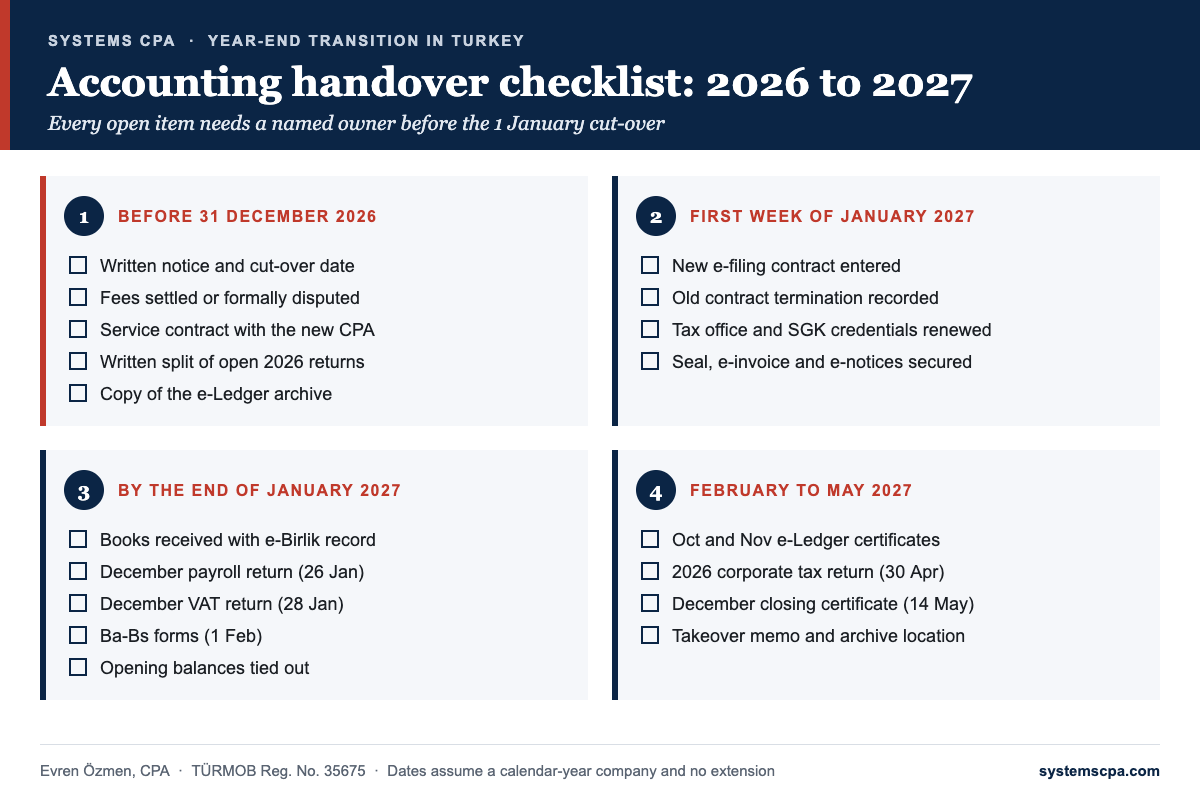
The financial year does not close on 31 December. Some returns and e-Ledger certificates for 2026 fall due in 2027, so a company that changes provider on 1 January needs a named owner for every open item before the cut-over. Use this accounting handover checklist with both providers, and keep the signed copy with the takeover memo.
Before 31 December 2026
- ☐ Written notice to the current provider, with the cut-over date
- ☐ Fees to the current provider settled or formally disputed
- ☐ Service contract signed with the new CPA
- ☐ Written split of every open 2026 return and e-Ledger month
- ☐ Copy of the e-Ledger archive since the company joined the system
First week of January 2027
- ☐ New e-filing intermediary contract entered; termination of the old one recorded within 15 days
- ☐ Tax office and SGK credentials renewed in the company’s name
- ☐ Financial seal, e-invoice provider account and e-notification inbox secured
- ☐ Opening trial balance received for testing
By the end of January 2027
- ☐ Books and documents received with the e-Birlik handover record (within 30 days)
- ☐ December 2026 payroll return (26 January) and VAT return (28 January) filed by the agreed owner
- ☐ December 2026 Ba-Bs forms filed (1 February 2027)
- ☐ Opening balances tied to bank, tax office, VAT carried forward, SGK and intercompany
February to May 2027
- ☐ e-Ledger certificates for October and November 2026 (15 February and 15 March 2027)
- ☐ Year-end adjustments agreed and the 2026 corporate tax return filed (30 April 2027)
- ☐ Closing e-Ledger certificate for December 2026 (14 May 2027)
- ☐ Takeover memo and archive location documented
Dates assume a calendar-year company with monthly payroll returns and monthly e-Ledger uploads, and no extension announced by the Revenue Administration. The day-by-day sequence and the legal basis are explained in our guide to the accounting takeover process in Turkey.
How SystemsCPA Structures an Accounting Takeover
Define the cut-off
We agree which period the outgoing provider will complete and the exact date from which SystemsCPA will assume the ongoing accounting scope.
Map every filing responsibility
VAT, withholding, payroll, provisional tax, corporate tax, e-ledger and any special reporting obligations are assigned so that no period falls between two providers.
Collect the accounting data
We request the general ledger, trial balance, filed returns, payroll records, reconciliations, digital records and supporting schedules relevant to the company.
Review the opening balance sheet
Material accounts are reconciled or supported. Unclear balances are not silently accepted; they are placed on an issues list with the required follow-up.
Reconcile payroll and tax positions
Payroll liabilities, social security, VAT and withholding positions are compared with the accounting records and available filing evidence.
Align the books with headquarters
We confirm reporting currency, group chart mapping, cost centres, intercompany requirements, close deadlines and the format expected by the parent finance team.
Start the recurring close process
The takeover moves into a recurring monthly cycle: bookkeeping, reconciliations, tax compliance, payroll coordination and agreed management / group reporting.
Who Is Responsible During the Transition?
| Party | Primary role in the handover |
|---|---|
| Company management | Approve the change, define timing and ensure both providers can exchange the required company records. |
| Outgoing accountant | Complete the agreed scope and transfer accounting, filing and supporting information for the periods handled. |
| Incoming accountant | Establish the new professional arrangements, review opening information and assume the agreed ongoing scope. |
| Parent / group finance | Define reporting deadlines, group chart mapping, intercompany expectations and consolidation requirements. |
Direct professional communication between the incoming and outgoing accounting teams is usually more efficient than asking company management to translate technical accounting issues between them.
What Should Headquarters Receive After the Takeover?
A successful transition should improve the finance process, not simply replace the name of the accounting firm. For an operating foreign subsidiary, the monthly output may include the following depending on scope:
| Reporting area | Typical output |
|---|---|
| Financial statements | Monthly P&L, balance sheet, trial balance and supporting schedules. |
| Cash | Bank reconciliations, cash position and significant movements. |
| Working capital | Accounts receivable / payable ageing and material overdue items. |
| Tax | VAT, withholding, payroll and corporate-tax positions relevant to the period. |
| Intercompany | Reconciled group balances and a list of differences requiring resolution. |
| Payroll | Payroll cost summary and reconciliation to the general ledger. |
| Fixed assets | Additions, disposals and depreciation schedules. |
| Open issues | Accounting, tax or compliance matters that require management action. |
Accounting Takeover vs. Ordinary Bookkeeping
Ordinary bookkeeping starts with the assumption that the opening data is usable. A takeover cannot make that assumption. The first months may require additional work to validate the inherited accounting position and to separate historical issues from current-period accounting.
Ordinary monthly bookkeeping
- Record current-period transactions.
- Prepare recurring tax filings.
- Process agreed reconciliations.
- Deliver recurring reports.
Accounting takeover
- Validate the inherited trial balance.
- Confirm historical tax and payroll continuity.
- Identify unsupported or aged balances.
- Build a documented remediation list.
- Re-design the close and group-reporting process where required.
Questions a CFO Should Ask Before Appointing a New Turkish Accounting Provider
- Who will be our day-to-day English-speaking finance contact?
- When will the monthly trial balance be available after month-end?
- Which balance-sheet accounts do you reconcile every month?
- How do you validate opening balances from the previous provider?
- Can you reconcile intercompany accounts directly with group finance?
- Can your reporting timetable match our consolidation close?
- Can you map Turkish statutory accounts to our group chart of accounts?
- How do you document inherited accounting or tax issues?
- How is payroll reconciled to the general ledger?
- Who is responsible for monitoring VAT, withholding and corporate-tax exposures?
- How are e-ledger and electronic declaration responsibilities handled during transition?
- What exactly will headquarters receive each month?
The quality of the answer is more important than the length of the service list. A provider that can describe its close, reconciliation and escalation process clearly is easier for a group finance team to manage.
Frequently Asked Questions
Can a company change its accountant in Turkey during the financial year?
Yes, a transition can generally be implemented during the year. The company should define the cut-off date, filing responsibilities, professional authorisations and transfer of accounting records before the new provider begins its recurring scope.
Do we need to wait until 31 December to change accountants?
Not necessarily. A month-end cut-over is often operationally cleaner. The best timing depends on payroll, tax filings, e-ledger processes, audits and the parent company’s reporting calendar.
What should the previous accountant transfer?
The exact list depends on the company, but it commonly includes ledgers, trial balances, filed tax returns, payroll records, e-ledger records where applicable, bank reconciliations, fixed-asset schedules, receivable and payable details, intercompany balances and unresolved tax or accounting matters.
What is the biggest risk when changing accountants in Turkey?
One of the most important risks is accepting unsupported opening balances. If an inherited balance is wrong or unexplained, the problem can continue affecting future tax calculations and management reporting.
Can the new accountant correct historical accounting issues?
Potentially, but the required action depends on the issue and period involved. The first step is to identify and document the historical item, determine its accounting and tax impact, and then decide whether a correction, amended filing or other remediation is appropriate.
Should the new accountant speak directly with the old accountant?
Direct professional communication is often useful, especially for reconciliations, filing history, e-ledger records and unresolved balances. It reduces the risk of technical information being lost through an administrative intermediary.
Can SystemsCPA provide management reporting after the takeover?
Yes. Depending on scope, the recurring service can combine Turkish statutory accounting and tax compliance with management reporting, group chart-of-accounts mapping, intercompany reconciliation and support for the parent company’s monthly close.
How long does an accounting takeover take?
For a company with clean electronic records, about 30 days: one week to move filing authority and system access, then the handover record, the opening-balance check and the first returns. A company with unresolved balances, payroll complexity, inventory, multiple currencies or delayed records may need a longer remediation phase, agreed after reviewing the current accounting position.
What should a year-end accounting handover checklist cover for a 1 January 2027 switch in Turkey?
A year-end accounting handover checklist for a 1 January 2027 switch in Turkey covers four windows: before 31 December (notice, fees, contract, a written split of open returns and a copy of the e-Ledger archive), the first week of January (filing authority and credentials), the end of January (handover record and December returns) and February to May (the remaining e-Ledger certificates and the 2026 corporate tax return).
Related Guide: Changing Accountants in Turkey
If you are still evaluating whether a provider change is necessary, read our CFO-focused guide on the warning signs, transition risks and questions to ask before changing accountants in Turkey.
Read: How to Change Your Accountant in Turkey — Without a Compliance Gap
Official Reference Framework
This page is designed as operational guidance for foreign-owned companies and should be read together with the current rules and filing calendars applicable to the company.
- Turkish Revenue Administration (GİB) — electronic declaration framework and professional intermediation / responsibility agreements.
- Turkish Revenue Administration (GİB) — 2026 Tax Calendar, including tax filing and e-ledger certificate deadlines.
- Tax Procedure Law No. 213 and the applicable secondary legislation governing statutory books, electronic declarations and tax records.
- Law No. 3568 and the professional framework applicable to Turkish certified public accountants (SMMM).
- e-Ledger General Communiqué No. 1 — e-Ledger certificate deadlines and secondary-copy storage rules.
- Turkish Commercial Code No. 6102, Art. 82 — ten-year retention of commercial books.
Considering a Change of Accounting Provider in Turkey?
Send us your current reporting setup, approximate transaction volume, employee count, accounting software and preferred transition date. We can define the takeover scope, information request, opening-balance review and recurring monthly reporting framework before the cut-over. The accounting handover checklist on this page is the starting point.
Request an Accounting Handover Review Explore Accounting ServicesThis material is general information and does not constitute a tax audit, statutory audit or legal opinion. Scope and filing responsibilities should be confirmed for the specific company before transition.
Turn Turkey compliance into certainty
SYSTEMS CPA supports foreign-owned companies with company formation, accounting, tax compliance and payroll in Turkey — one accountable local partner. Reviewed by Evren Özmen, SMMM (Certified Public Accountant), TÜRMOB Reg. No. 35675.
